
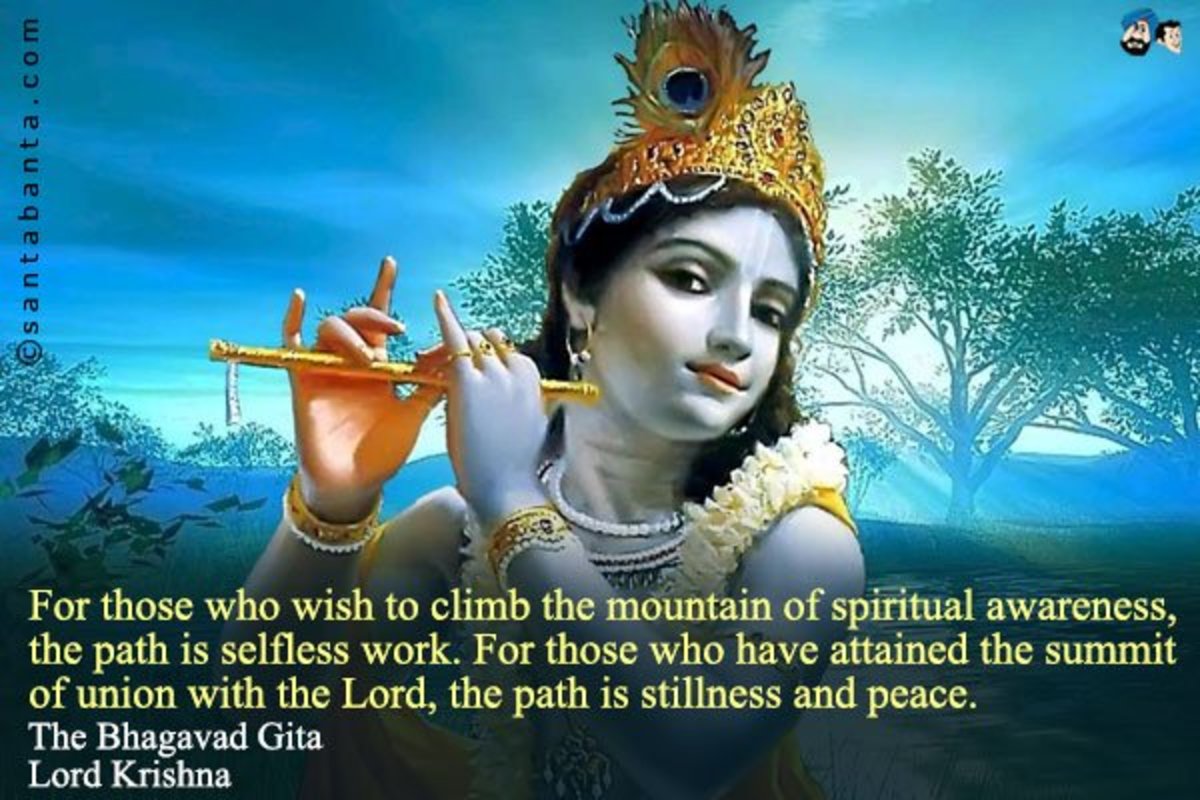
BHAGAVAD-GITA in ENGLISH
Author: Sage Veda Vyasa
“Let noble thoughts come to us from everywhere”
(The Vedas)
The Bhagavad-Gita is a doctrine of universal truth and a book
of moral and spiritual growth. Its message is sublime and non-sec
tarian. It deals with the most sacred metaphysical science. It im
parts the knowledge of the Self and answers two universal ques
tions: Who am I, and how can I lead a happy and peaceful life in
this word full of dualities and dilemmas?
It’s a timeless book of wisdom that inspired Thoreau, Emerson,
Einstein, Oppenheimer, Gandhi and many others. The Bhagavad
Gita teaches us how to equip ourselves for the battle of life. A re
peated study with faith purifies our psyche and guides us to face
the challenges of modern living leading to inner peace and happi
ness.
Gita teaches the spiritual science of Self-realization (SR) based
on the essence of Upanishads and Vedanta. The prime message
of the Gita is: The ultimate purpose of life is to realize one’s essen
tial nature and become one with the Supreme Self within all of us.
It assures spiritual progress for all humans, and how to be one with
the Supreme. Its teachings are profound, universal, uplifting, and
sublime.
The ignorance of metaphysical or Spiritual knowledge—not
knowing our real identity—is humanity’s greatest predicament. It is
said that there is no human mind that cannot be purified by a re
peated study of the Gita. Gita explains the basic principles of spir
itual science— using Sanskrit poetry— in a very clear and inspiring
manner. Sacred relationship between the Creator and the creation
is well established in the Gita. If one lives in the spirit of even a few
verses of the Gita, one’s life will be transformed into divinity.
The philosophy of duty, devotion and Self-knowledge is won
derfully synthesized and harmonized in the Gita—without creating
any conflict among them—to give the reader eternal bliss, everlast
ing peace and perennial joy in life. It awakens Cosmic Conscious
ness and stimulates life with spirituality. Religion tends to create a
wall of division and conflicts along religious lines. Whereas, spirit
uality unites people by breaking those walls. A spiritual person is a
2
International Gita Society
friend of all and a foe of none, because he considers all crea
tures—living or non-living—as part and parcel of the Cosmic body
of the Absolute, the Source.
The message of the Gita came to humanity due to Arjuna’s
unwillingness to do his duty as a warrior, because fighting involved
destruction and killing. Nonviolence or Ahinsa is one of the most
fundamental tenets of spiritual culture. All lives, human or non-hu
man, are sacred. This immortal discourse between the Supreme
Lord, Krishna, and His devotee-friend, Arjuna, occurs not in a tem
ple, a secluded forest, or on a mountain top; but on a battlefield on
the eve of a big war. Anyone can be helped by practice of only a few of
its teachings. No change of one’s faith or life-style is needed!
A total of seven hundred (700) verses of the Gita, in 18 chap
ters, are recorded in world’s longest epic, Mahabharata, having
over 100,000 verses in Sanskrit poetry. In Gita Lord Krishna ad
vises Arjuna to get up and fight. This may create a misunderstand
ing of the principles of non-violence if the background of the war of
Mahabharata is not kept in mind. Therefore, a brief historical de
scription is in order.
In ancient times there was a king who had two sons, Dhri
tarashtra and Pandu. The former was born blind; therefore, Pandu
inherited the kingdom. Pandu had five sons. They were called the
Pandavas. Dhritarashtra had one hundred sons. They were called
the Kauravas. Duryodhana was the eldest of the Kauravas.
After the death of king Pandu, the eldest son of Pandu became
the lawful King. Duryodhana was a very jealous person. He also
wanted the kingdom. The kingdom was divided into two halves be
tween the Pandavas and the Kauravas. Duryodhana was not sat
isfied with his share of the kingdom. He wanted the entire kingdom
for himself. He unsuccessfully planned several foul plays to kill the
Pandavas and take away their kingdom also. He unlawfully took
possession of the entire kingdom of the Pandavas and refused to
give back even an acre of land without a war. All mediation by Lord
Krishna and others failed. The big war of Mahabharata was thus
inevitable. The Pandavas were unwilling participants. They had
only two choices: Fight for their right as a matter of duty or run
away from war and accept defeat for the sake of peace and nonvi
olence. Arjuna, one of the five Pandava brothers, faced this di
lemma in the battlefield: Whether to fight or run away from war for
peace.
Arjuna’s dilemma is, in reality, the Universal Dilemma. All hu
man beings face dilemmas, big or small, in their everyday life while
performing their duties. Arjuna’s dilemma was a big one. He had to
make a choice between fighting the war and killing his most
revered guru who was on the other side, very dear friends, close
relatives, and many innocent warriors; or running away from the
Bhagavad-Gita
3
battlefield for the sake of preserving peace and nonviolence. The
entire seven hundred verses of the Bhagavad-Gita are a discourse
between Lord Krishna and the confused Arjuna on the battlefield
near New Delhi, India, in 3,139 BCE. This discourse was narrated
to the blind king, Dhritarashtra, by his charioteer, Sanjaya, as an
eyewitness war report.
The word ‘Bhagavad’ means the Supreme Being, God or Bha
gavan in Sanskrit. ‘Gita’ means song. Thus, Bhagavad-Gita means
the Song of God or The Celestial Song, because it was sung by
Bhagavan Lord Krishna, an incarnation of God Himself.
CHAPTER 1
- Arjuna’s Dilemma
The blind King inquired from his charioteer: O Sanjaya, tell me
in detail, what did my sons and the Pandavas do in the battlefield
before the war started? (1.01)
Chapter Summary
Sanjaya said: Arjuna asked his charioteer-friend, Lord Krishna,
to drive his chariot between the two armies so that he could see
the armies on both sides. Arjuna felt great compassion to see his
friends and relatives on the opposite side, whom he must kill to win
this war. He became confused, spoke of the evils of war, and re
fused to fight or do his duty as a warrior.
Arjuna sat down on the back seat of the chariot with his mind
overwhelmed with sorrow. (Verse 1.47)
NOTE: Some non-essential verses from Chapters 1 and 2 only
have been omitted for ease of understanding the teachings of the
Gita by the first time readers.
CHAPTER 2 - Spiritual knowledge
Sanjaya said: Lord Krishna spoke these words to Arjuna whose
eyes were tearful and downcast, and who was overwhelmed with
compassion and despair. (2.01) O King, Lord Krishna, as if smiling,
spoke these words to distressed Arjuna in the midst of the two ar
mies. (2.10)
Teachings of the Gita begins
Important verses are highlighted. First time readers should
read and understand these verses first.
4 International Gita Society
The Supreme Lord said: You grieve for those who are not wor
thy of grief; and yet speak words of wisdom. The wise grieve nei
ther for the living nor for the dead. (2.11) There was never a time
when these monarchs, you, or I did not exist, nor shall we ever
cease to exist in the future. (2.12) Just as a living being acquires a
childhood body, a youth body, and an old-age body during this life;
similarly, it acquires another new body after death. The wise are
not deluded by this. (2.13) The contacts of the senses with the
sense objects give rise to the feelings of heat and cold, pain and
pleasure. They are transitory and impermanent. Therefore, learn
to endure them, O Arjuna, (2.14) because a calm person — who is
not afflicted by these sense objects, and is steady in pain and
pleasure — becomes fit for immortality, O Arjuna. (2.15)
The spirit is eternal, body is transitory
The invisible Spirit is eternal, and the visible world, including
the physical body, is transitory. The reality of these two is indeed
certainly seen by the seers of Truth. (2.16) The Spirit by which all
this universe is pervaded is indestructible. No one can destroy the
imperishable Spirit. (2.17) Bodies of the eternal, immutable, and
incomprehensible Spirit are perishable. Therefore, fight, O Arjuna.
(2.18) One who thinks that Spirit is a slayer, and one who thinks
Spirit is slain, are both ignorant. Because Spirit neither slays nor is
slain. (2.19) The Spirit is neither born nor does it die at any time. It
does not come into being, or cease to exist. It is unborn, eternal,
permanent, and primeval. The Spirit is not destroyed when the
body is destroyed. (2.20) O Arjuna, how can a person who knows
that the Spirit is indestructible, eternal, unborn, and immutable, kill
anyone or cause anyone to be killed? (2.21)
Death and Reincarnation of the soul
Just as a person puts on new garments after discarding the old
ones; similarly, the living entity acquires new bodies after casting
away the old bodies. (2.22) Weapons do not cut this Spirit, fire
does not burn it, water does not make it wet, and the wind does not
make it dry. Spirit cannot be cut, burned, wet, or dried. It is eternal,
all-pervading, unchanging, immovable, and primeval. (2.23-24)
The Spirit is said to be unexplainable, incomprehensible, and un
changing. Knowing this Spirit as such, you should not grieve. (2.25)
Even if you think that this living being takes birth and dies per
petually, even then, O Arjuna, you should not grieve like this. Be
cause, death is certain for one who is born, and birth is certain for
one who dies; and the cycle of birth-death continues. Therefore,
you should not lament over the inevitable. (2.26-27) All beings, O
Arjuna, are unmanifest — invisible to our physical eyes — before
birth and after death. They manifest between the birth and the
death only. What is there to grieve about? (2.28) Some look upon
Bhagavad-Gita
5
this Spirit as a wonder, another describes it as wonderful, and oth
ers hear of it as a wonder. Even after hearing about it very few
people know it. (2.29) O Arjuna, the Spirit that dwells in the body
of all beings is eternally indestructible. Therefore, you should not
mourn for anybody. (2.30)
Duty of a warrior
Considering also your duty as a warrior, you should not waver.
Because there is nothing more auspicious for a warrior than a right
eous war. (2.31) Only the fortunate warriors, O Arjuna, get such an
opportunity for a righteous war against evil that is like an open door
to heaven. (2.32)
Commentary
The righteous war is not a religious war against the
followers of other religions. The righteous war may be waged
even against our own evil-doer kith and kin (RigVeda
6.75.19). Life is a continuous battle between the forces of evil
and goodness. “Whosoever kills an innocent human being, it shall
be regarded as if he has killed the entire humanity.” (Surah 5.32).
It is better to die for a right cause and acquire the grace of
sacrifice than to die an ordinary but compulsory death. The gates
of heaven open wide for those who stand up to vindicate justice
and righteousness (Dharma). Not to oppose an evil is to indirectly
support it. Very similar ideas are expressed in other scriptures of
the world. The Bible says: Happy are those who suffer persecution
because they do what God requires. The kingdom of heaven
belongs to them (MATTHEW 5.10). There is no sin in killing an
aggressor. Whosoever helps and supports an aggressor is also an
aggressor. Thus, all those who supported Kauravas were basically
aggressors and deserved to be eliminated.
If you will not fight this righteous war, then you will fail in your
duty, lose your reputation, and incur sin. (2.33) People will talk
about your disgrace forever. To the honored, dishonor is worse
than death. (2.34) The great warriors will think that you have re
treated from the battle out of fear. Those who have greatly es
teemed you will lose respect for you. (2.35) Your enemies will
speak many unmentionable words and scorn your ability. What
could be more painful to you than this? (2.36) You will go to heaven
if killed in the line of duty, or you will enjoy the kingdom on the earth
if victorious. Therefore, get up with a determination to fight, O Ar
juna. (2.37) Treating pleasure and pain, gain and loss, and victory
and defeat alike, engage yourself in your duty. By doing your duty
this way, you will not incur sin. (2.38)
Importance of Karma-yoga, the selfless action
The wisdom of spiritual knowledge has been imparted to you,
O Arjuna. Now listen to the wisdom of Karma-yoga, the selfless
6
International Gita Society
service (Seva), endowed with which you will free yourself from the
bondage or reactions of action (Karma). (2.39) In Karma-yoga, no
effort is ever lost and there is no adverse effect. Even a little prac
tice of this discipline protects one from the great fear of birth and
death. (2.40) A Karma-yogi has a resolute determination for God
realization, O Arjuna, but the desires of one who works to enjoy the
fruits of work are endless. (2.41)
Material and spiritual aspects of life
The misguided ones who delight in the melodious chanting of
the Vedas or any scripture — without understanding its real pur
pose — think, O Arjuna, as if there is nothing else in it except the
rituals for the sole purpose of obtaining heavenly enjoyment. (2.42)
They are dominated by material desires and consider the attain
ment of heaven as the highest goal of life. They engage in specific
rites for the sake of prosperity and enjoyment. Rebirth is the result
of their action. (2.43) The resolute determination of Self-realization
is not formed in the minds of those who are attached to pleasure
and power and whose judgment is obscured by such ritualistic ac
tivities. (2.44) A portion of the Vedas deals with three modes or
states of the material Nature. Become free from pairs of opposites;
be ever balanced and unconcerned with the thoughts of acquisition
and preservation. Rise above the three states, and be Self-con
scious, O Arjuna. (2.45) To a Self-realized person, scriptures are
as useful as a small reservoir of water when the water of a huge
lake becomes available. (2.46)
Theory and practice of Karma-yoga
You have control over your respective duty only, but no control
or claim over the results. The fruits of work should not be your only
motive and you should never be inactive. (2.47) Do your duty to
the best of your ability, O Arjuna, with your mind attached to the
Lord, abandoning worry and attachment to the results, and remain
ing calm in both success and failure. The calmness of mind is
called Karma-yoga. (2.48) Work done with selfish motives is infe
rior by far to selfless service or Karma-yoga. Therefore, be a
Karma-yogi, O Arjuna. Those who work only to enjoy the fruits of
their labor are, in truth, unhappy. Because, one has no control over
the results. (2.49)
A true Karma-yogi becomes free from both vice and virtue in
this very life. Therefore, strive for Karma-yoga. Working to the best
of one’s abilities without becoming attached to the fruits of work is
called Karma-yoga. (2.50) Wise Karma-yogis are freed from the
bondage of rebirth by renouncing attachment to the fruits of all
work and attain a blissful divine state. (2.51) When your intellect
completely pierces the veil of confusion, then you will become in
different to what has been heard and what is to be heard from the
scriptures. (2.52)
Bhagavad-Gita
7
When your intellect, that is confused by the conflicting opinions
and the ritualistic doctrine of the Vedas, shall stay steady and firm
on concentrating on the Supreme Being, then you shall attain union
with the Supreme Being in trance. (2.53) Arjuna said: O Krishna,
what are the marks of an enlightened person whose intellect is
steady? How does a person of steady intellect speak? How does
such a person sit and walk? (2.54)
Marks of a Self-realized person
The Supreme Lord said: When one is completely free from all
desires of the mind and is satisfied with the Eternal Being (God) by
the joy of Eternal Being, then one is called an enlightened person,
O Arjuna. (2.55) A person whose mind is unperturbed by sorrow,
who does not crave pleasures — and who is completely free from
attachment, fear, and anger— is called a sage of steady mind.
(2.56) Those who are not attached to anything, who are neither
elated by getting desired results, nor troubled by undesired results,
their intellect is considered steady. (2.57) When one can com
pletely withdraw the senses from its sense objects— as a tortoise
withdraws its limbs into the shell for protection from dangers— then
the intellect of such a person is considered steady. (2.58) The de
sire for sensual pleasures fades away if one abstains from sense
enjoyment, but the craving for sense enjoyment remains. The crav
ing also disappears from one who has known the Supreme Being.
(2.59)
Dangers of unrestrained senses
Restless senses, O Arjuna, forcibly carry away the mind of
even a wise person striving for perfection. (2.60) One should fix
one’s mind on Me with loving contemplation after bringing the
senses under control. One’s intellect becomes steady when one’s
senses are under complete control. (2.61) One develops attach
ment to sense objects by thinking about sense objects. Desire for
sense objects comes from attachment to sense objects, and anger
comes from unfulfilled desires. (2.62) Delusion or wild ideas arise
from anger. The mind is bewildered by delusion. Reasoning is de
stroyed when the mind is bewildered. One falls from the right path
when reasoning is destroyed. (2.63)
Peace through sense control and Self-knowledge
A disciplined person, enjoying sense objects with senses that
are under control and free from likes and dislikes, attains tranquil
ity. (2.64) All sorrows are destroyed upon attainment of tranquility.
The intellect of such a tranquil person soon becomes completely
steady and united with the Source. (2.65) There is neither Self
knowledge nor Self-perception to those who are not united with the
Eternal Being. Without Self-perception there is no peace, and with
out peace there can be no happiness. (2.66)
8 International Gita Society
The mind, when controlled by roving senses, steals away the
intellect as a storm takes away a boat on the sea from its destina
tion — the spiritual shore. (2.67) Therefore, O Arjuna, one’s intel
lect becomes steady when the senses are completely withdrawn
from its sense objects. (2.68) A yogi, the person of self-restraint,
remains wakeful when it is night for all others. It is night for a yogi
who sees when all others are wakeful. (2.69)
NOTE: What is considered real by a yogi is of no value for
a worldly person and vice-versa.
One attains peace when all desires dissipate within the mind
without creating any mental disturbance, just as river waters enter
the full ocean without creating any disturbance. One who desires
material objects is never peaceful. (2.70) One who abandons all
desires, and becomes free from longing and the feeling of “i” and
“my”, attains peace. (2.71) O Arjuna, this is the superconscious
state of mind. Attaining this state, one is no longer deluded. Gain
ing this state, even at the end of one’s life, a person attains Nirvana
(or becomes one with the Absolute). (2.72)
CHAPTER 3
- Path of Selfless service, Karma-yoga
Arjuna said: If You consider acquiring spiritual knowledge is
better than working, then why do You want me to engage in this
horrible war, O Krishna? You seem to confuse my mind by appar
ently conflicting words. Tell me, decisively, one thing by which I
may attain the Supreme. (3.01-02) The Supreme Lord said: In this
world, O Arjuna, a twofold path of spiritual discipline has been
stated by Me in the past — the path of Self-knowledge for the con
templative, introverts and the path of unselfish work (Seva, Karma
yoga) for all others. (3.03) One does not attain freedom from the
bondage of Karma by merely abstaining from work. No one attains
perfection by merely giving up work. (3.04) Because no one can
remain actionless even for a moment, everyone is driven to action
— helplessly indeed — by the forces of nature. (3.05) The deluded
ones, who restrain their organs of action but mentally dwell upon
the sense enjoyment, are called hypocrites. (3.06)
Why one should serve others?
One who controls the senses by a trained and purified mind
and intellect, and engages the organs of action to selfless service,
is superior, O Arjuna. (3.07) Perform your obligatory duty because
working is indeed better than sitting idle. Even the maintenance of
your body would be impossible without work. (3.08) Human beings
are bound by work that is not performed as a selfless service.
Therefore, O Arjuna, becoming free from attachment to the fruits
of work, do your duty efficiently as a service to Me. (3.09) - Bhagavad-Gita
- 9
- The first commandment of the creator
- Brahma, the creator, in the beginning created human beings
- together with selfless service (Seva, sacrifice) and said: By Seva
- or sacrifice of self-interest you shall prosper, and Seva shall fulfill
- all your desires. (3.10) Help the celestial controllers (Devas) with self
- less service and they will help you. Thus helping each other, you shall
- attain the Supreme goal of human life. (3.11) The celestial control
- lers, pleased by selfless service, will give you desired objects even
- without asking for it. One who enjoys the gift of celestials without
- offering them anything in return is, indeed, a thief. (3.12) The right
- eous who eat the remnants of selfless service are freed from all
- sins, but the impious who cook food only for themselves (without
- first offering to Me, or sharing with others), in truth, eat sin (3.13).
- The physical body of living beings is made up of and sustained by
- food; food is created by God from five basic elements. God is
- pleased by the sacrifice (Qurbani) of self-interest: The selfless phil
- anthropic work, and blesses selfless persons. Selfless work or sac
- rifice is our duty. Duty is prescribed in the scriptures. The scriptures
- come from God. Thus, the all-pervading God is ever present in
- selfless service, Seva. (3.14-15) One who does not help to keep
- the wheel of creation in motion by sacrificial duty and who rejoices
- sense pleasures only, that sinful person lives in vain, O Arjuna.
- (3.16) For a Self-realized person, who rejoices only with God, who
- is delighted with God and who is content with God, there is no duty.
- (3.17) Such a person has no interest, whatsoever, in what is done
- or what is not done. A Self-realized person does not depend on
- anybody, except God, for anything. (3.18)
- Leaders should set an example
- Therefore, always perform your duty efficiently and without any
- attachment to the results, because by doing work without attach
- ment one attains the Supreme Being. (3.19) King Janaka and oth
- ers attained perfection (or Self-realization) by selfless service
- (Karma-yoga) alone. You should also perform your duty with a view
- to guide people, and for universal welfare of the society. (3.20)
- Whatever noble persons do, others follow. Whatever standard they
- set up, the world follows. (3.21) O Arjuna, there is nothing in the
- three worlds (heaven, earth, and the lower regions) that should be
- done by Me, nor there is anything that I should obtain, yet I engage
- in action. (3.22) If I do not engage in action relentlessly, O Arjuna,
- people would follow My path. These worlds would perish if I do not
- work, and I would be the cause of confusion and destruction of all
- these people. (3.23-24) As the ignorant work, O Arjuna, with at
- tachment to the fruits of work, so the wise should work without at
- tachment, for the welfare of the society. (3.25) The wise should not
- unsettle the minds of the ignorant, who are attached to the fruits of
- 10 International Gita Society
- work, but should inspire others by performing all works, efficiently,
- without attachment to results. (3.26)
- All works are the works of Nature
- All work is done by the energy and power of nature, but due to
- delusion of ignorance, people assume themselves to be the doer
- and thus incur sin or Karmic bondage. (3.27) One who knows the
- truth, O Arjuna, about the role of the forces of nature and work,
- does not become attached to work, knowing very well that it’s the
- forces of nature that work with their instruments — our organs.
- (3.28) Those who are deluded by the illusive power (Maya) of Na
- ture become attached to the work done by the forces of nature.
- The wise should not disturb the mind of the ignorant whose
- knowledge is imperfect. (3.29) Do your duty — dedicating all work
- to Me — in a spiritual frame of mind, free from desire, attachment,
- and mental grief. (3.30) Those who always practice this teaching
- of Mine — with faith, sincerity and free from complain — are freed
- from the bondage of Karma. But those who carp at My teaching
- and do not practice it, should be considered ignorant of all
- knowledge, senseless, and lost. (3.31-32) All beings follow their
- nature. Even the wise act according to their own nature. What,
- then, is the value of sense restraint? (3.33)
- Two stumbling blocks on the path
- Likes and dislikes for sense objects remain in the senses. One
- should not come under the control of these two, because they are,
- indeed, two major stumbling blocks on one’s path of Self-realiza
- tion. (3.34) One’s inferior natural work is better than superior un
- natural work. Death in carrying out one’s natural work is useful.
- Unnatural work produces too much stress. (3.35)
- Lust is the origin of sin
- Arjuna said: O Krishna, what impels one to commit sin as if
- unwillingly and forced against one’s will? (3.36) The Supreme Lord
- said: It is lust (or intense desire for material and sensual pleas
- ures), born out of passion, that becomes anger when unfulfilled.
- Lust is insatiable and is a great devil. Know this as the enemy.
- (3.37) As the fire is covered by smoke, as a mirror by dust, and as
- an embryo by the amnion, similarly Self-knowledge becomes ob
- scured by lust. (3.38) O Arjuna, Self-knowledge becomes covered
- by this insatiable fire of lust, the eternal enemy of the wise. (3.39)
- The senses, the mind, and the intellect are said to be the seat of
- lust. Lust — by controlling the senses, the mind, and the intellect
- — deludes a person by veiling Self-knowledge. (3.40) Therefore,
- O Arjuna, by controlling the senses first, kill this devil of material
- desire that destroys Self-knowledge and Self-realization. (3.41)
- How to control lust
- The senses are said to be superior to the body; the mind is
- superior to the senses; the intellect is superior to the mind; and
- Bhagavad-Gita
- 11
- Spirit is superior to the intellect. (3.42) Thus, knowing the Spirit to
- be superior to the intellect, and controlling the mind by the intellect
- that is purified by spiritual practices, one must kill this mighty en
- emy, lust, O Arjuna. (3.43)
- CHAPTER 4
- Path of renunciation with Self-knowledge
Karma-yoga is an ancient law
The Supreme Lord said: I taught this Karma-yoga, the eternal
science of selfless action, to King Vivasvan. Vivasvan taught it to
Manu. Manu taught it to Ikshvaku. Thus handed down in succes
sion the saintly Kings knew this. After a long time the science of
Karma-yoga was lost from this earth. Today I have described the
same ancient science to you because you are my sincere devotee
and friend. Karma-yoga is the supreme secret indeed. (4.01-03)
Arjuna said: You were born later, but Vivasvan was born in ancient
time. How am I to understand that You taught this Karma-yoga in
the beginning of the creation? (4.04)
The purpose of incarnation of God
The Supreme Lord said: Both you and I have taken many
births. I remember them all, O Arjuna, but you do not remember.
(4.05) Though I am eternal, immutable, and the Lord of all beings,
yet I manifest myself by controlling My own material Nature, using
My divine potential energy (Maya). (4.06) Whenever there is a de
cline of Dharma (Righteousness) and a predominance of Adharma
(or Unrighteousness), O Arjuna, then I manifest Myself. I appear
from time to time for protecting the good, for transforming the
wicked, and for establishing world order (Dharma). (4.07-08) The
one who truly understands My transcendental appearance and ac
tivities of creation, maintenance, and dissolution, attains My su
preme abode and is not born again after leaving this body, O Ar
juna. (4.09) Many have become free from attachment, fear, anger,
and attained salvation by taking refuge in Me, becoming fully ab
sorbed in My thoughts, and becoming purified by the fire of Self
knowledge. (4.10)
Path of worship and prayer
With whatever motive people worship Me, I fulfill their desires
accordingly. People worship Me with different motives. (4.11)
Those who long for success in their work here on the earth worship
the celestial controllers. Success in work comes quickly in this hu
man world. (4.12) The four divisions — based on aptitude and vo
cation — of human society were created by Me. Though I am the
author of this system of the division of labor, one should know that
I do nothing and I am eternal. (4.13) Work or Karma does not bind
Me, because I have no desire for the fruits of work. The one who
fully understands and practices this truth is also not bound by
Karma. (4.14) The ancient seekers of liberation also performed
12
International Gita Society
their duties with this understanding. Therefore, you should do your
duty as the ancients did. (4.15)
Attached, detached, and forbidden action
Even the wise ones are confused about what is action and what
is inaction. Therefore, I shall clearly explain what is action, knowing
that one shall be liberated from the evil of birth and death. (4.16)
The true nature of action is very difficult to understand. Therefore,
one should know the nature of attached or selfish action, the nature
of detached or selfless action, and also the nature of forbidden ac
tion. (4.17)
A Karma-yogi is not subject to the Karmic laws
The one who sees inaction in action, and action in inaction, is
a wise person. Such a person is a yogi and has accomplished eve
rything. (4.18)
To see inaction in action and vice versa is to understand that
the Lord does all the work indirectly through His power by using us.
He is the inactive actor. We are actively inactive, because we can
not do anything without the flow of His power. Therefore, we are
not the doer, just an instrument in His hands.
A person, whose desires have become selfless by being
roasted in the fire of Self-knowledge, is called a sage by the wise.
(4.19) The one who has abandoned attachment to the fruits of
work, and remains ever content and dependent on no one but God,
such a person — though engaged in activity — does nothing at all
and incurs no Karmic reaction, good or bad. (4.20) The one who is
free from desires, whose mind and senses are under control, and
who has renounced all proprietorship, does not incur sin — the
Karmic reaction — by doing bodily action. (4.21) Content with
whatever gain comes naturally by His will, unaffected by pairs of
opposites, free from envy, calm in success and failure, though en
gaged in work, such a Karma-yogi is not bound by Karma. (4.22)
The one who is free from attachment, whose mind is fixed in Self
knowledge, who does work as a service (Seva) to the Lord, all Kar
mic bonds of such a philanthropic person (Karma-yogi) dissolve
away. (4.23) God shall be realized by the one who considers eve
rything as a manifestation or an act of God. (Also see 9.16) (4.24)
Different types of spiritual practices
Some yogis perform the service of worship to celestial control
lers (Devas, guardian angels), while others study scriptures for
Self-knowledge. Some restrain their senses and give up their sen
sual pleasures. Others perform breathing and other yogic exer
cises. Some give charity and offer their wealth as a sacrifice. (4.25
Bhagavad-Gita
13
28) Those who are engaged in yogic practices, reach the breath
less state of trance (Samadhi) by offering inhalation into exhalation
and exhalation into inhalation as a sacrifice using yogic techniques.
(4.29) Others restrict their diet and offer their inhalations as sacri
fice into their inhalations. All these people are the knowers of sac
rifice, and are purified by their sacrifice. (4.30) Those who perform
selfless service obtain the nectar of Self-knowledge as a result of
their sacrifice and attain the Eternal Being. O Arjuna, even this
world is not a happy place for the non-sacrificer, how can the other
world be? (4.31) Many types of spiritual disciplines are described
in the Vedas. Know them all to be born from Karma or the action
of body, mind, and senses. Knowing this, you shall attain Nirvana.
(4.32)
A superior spiritual practice
The acquisition and propagation of Self-knowledge are supe
rior to any material gain or gift, O Arjuna. Because all actions in
their entirety culminate in knowledge. (4.33) Acquire this spiritual
knowledge from a Self-realized guru by humble reverence, by sin
cere inquiry, and by service. The wise ones who have realized the
Truth will teach you. (4.34) After knowing the Truth, O Arjuna, you
shall not again become deluded like this. By this knowledge you
shall behold the entire creation first within Me, the Supreme Being,
then within your own higher self and then see Me alone in every
thing. (4.35) Even if one is the most sinful of all sinners, one shall
yet cross over the ocean of sin by the raft of Self-knowledge. (4.36)
As the blazing fire reduces wood to ashes; similarly, the fire of Self
knowledge reduces all bonds of Karma (or sin) to ashes, O Arjuna.
(4.37)
Spiritual knowledge is revealed to a Karma-yogi
In truth, there is no purifier in this world like the true knowledge
of the Supreme Being. One who becomes purified by Karma-yoga
discovers this knowledge within, naturally, in due course of time.
(4.38) The one who has faith and is sincere in yogic practices and
has control over the senses, gains this spiritual knowledge. Having
gained this knowledge, one at once attains supreme peace. (4.39)
The irrational, the faithless, and the atheist perish. There is neither
this world, nor the world beyond, nor happiness for the disbeliever.
(4.40)
Knowledge, Karma-yoga are needed for Nirvana
Work (Karma) does not bind a person who has renounced work
by renouncing attachment to the fruits of work, and whose doubts
about the Self are completely destroyed by Self-knowledge, O Ar
juna. (4.41) Therefore, cut the ignorance-born doubt about the Su
preme Being abiding in your mind by the sword of Self-knowledge,
resort to Karma-yoga, and get up for the war, O Arjuna. (4.42)
14
International Gita Society
CHAPTER 5 - Path of renunciation
Arjuna said: O Krishna, You praise spiritual knowledge and
also performance of selfless service. Tell me, definitely, which one
is the better of the two. (5.01) The Supreme Lord said: The path of
Self-knowledge and the path of selfless service both lead to the
supreme goal. But, of the two, selfless service is superior to Self
knowledge. (5.02) A person should be considered a true Samnyasi
(renunciant) who neither likes nor dislikes. One is easily liberated
from Karmic bondage by becoming free from the pairs of oppo
sites, O Arjuna. (5.03)
Both paths lead to the Supreme
The ignorant — not the wise — consider the path of Self
knowledge (or renunciation) and the path of selfless service
(Karma-yoga) as different from each other. The person who has
truly mastered one, gets the benefits of both. (5.04) Whatever goal
a Samnyasi reaches, a Karma-yogi also reaches the same goal.
Therefore, the one who sees the path of renunciation and the path
of unselfish work as the same, really sees. (5.05) But, true renun
ciation, O Arjuna, is difficult to attain without Karma-yoga. A sage
equipped with Karma-yoga quickly attains God. (5.06) A Karma
yogi whose mind is pure, whose mind and senses are under con
trol, and who sees one and the same Eternal Being in all beings,
is not bound by Karma though intensely engaged in work. (5.07)
A Karma-yogi works for God only
The wise (or Samnyasi) who knows the truth thinks: “I do noth
ing at all”. In seeing, hearing, touching, smelling, eating, walking,
sleeping, breathing; and speaking, giving, taking, as well as open
ing and closing the eyes, a Samnyasi believes that only the senses
are operating upon their objects. (5.08-09) One who does all work
as an offering to the Lord — abandoning attachment to the results
— remains untouched by Karmic reaction or sin as a lotus leaf
never gets wet by water, while living in it. (5.10) The Karma-yogis
perform action —without attachment — with their body, mind, in
tellect, and senses only for self-purification. (5.11) A Karma-yogi
attains Supreme Bliss by abandoning attachment to the fruits of
work; while others, who are attached to the fruits of work, become
bound by selfish work. (5.12)
The path of Self-knowledge
A person who has completely renounced attachment to the
fruits of all works, lives happily, neither performing nor directing any
action. (5.13) The Lord neither creates the urge for action, nor the
feeling of doership, nor the attachment to the results of action in
people. All these are done by the powers of Nature. (5.14) The
Lord does not take the responsibility for the good or evil deeds of
Bhagavad-Gita
15
anybody. The Self-knowledge becomes covered by the veil of ig
norance; thereby people become deluded and do evil deeds. (5.15)
Spiritual knowledge destroys the ignorance of the Self and reveals
the Supreme, just as the Sun reveals the beauty of objects of the
world. (5.16) Persons whose mind and intellect are totally merged
with the Source, who are firmly devoted to the Source, who have
the Source as their supreme goal and sole refuge, and whose im
purities are destroyed by the knowledge of the Source, do not take
birth again. (5.17)
Additional marks of an enlightened person
An enlightened person — by perceiving the Lord in all — looks
at a learned and humble priest, an outcast, even a cow, an ele
phant, or a dog with an equal eye. (5.18) Everything has been ac
complished in this very life by the one whose mind is set in equality.
Such a person has realized God, because God is flawless and im
partial. (5.19) One who neither rejoices on obtaining what is pleas
ant, nor grieves on obtaining the unpleasant, who has a steady
mind, who is undeluded, and who is a knower of the Supreme Be
ing, such a person eternally abides with the Supreme Being. (5.20)
Such a person who is in union with the Supreme Being becomes
unattached to sensual pleasures by discovering the joy of the Self
through contemplation, and enjoys spiritual bliss. (5.21) Sensual
pleasures are, in truth, the source of misery, and have a beginning
and an end. Therefore, the wise do not rejoice sensual pleasures.
(5.22) One who is able to withstand the impulse of lust and anger
before death is a yogi, and a happy person. (5.23) One who finds
happiness with the Eternal Being, who rejoices Eternal Being
within, and who is illuminated by Self-knowledge; such a yogi at
tains Nirvana, and goes to Eternal Being. (5.24) Seers whose sins
(or imperfections) are destroyed, whose doubts have been dis
pelled by Self-knowledge, whose minds are disciplined, and who
are engaged in the welfare of all beings, attain the Supreme Being.
(5.25) They, who are free from lust and anger, who have subdued
the mind and senses, and who have known the Self, easily attain
Nirvana. (5.26)
Path of meditation and contemplation
A sage is liberated by renouncing all material enjoyments, fo
cusing the eyes and the mind between the eye-brows, equalizing
the breath moving through the nostrils by using yogic techniques,
keeping the senses, mind, and intellect under control, having sal
vation as the prime goal, and by becoming free from lust, anger,
greed and fear. (5.27-28) My devotee attains peace by knowing
Me, the Supreme Being as the enjoyer of sacrifices and austerities,
as the great Lord of all the universe, and the friend of all beings.
(5.29)
CHAPTER 6
16
International Gita Society - Path of meditation
A Karma-yogi is also a renunciant
The Supreme Lord said: One who performs the prescribed duty
without seeking its fruit only for personal enjoyment, is a renunciant
(Samnyasi) and a Karma-yogi. One does not become Samnyasi
merely by not lighting the fire, and one does not become a yogi
merely by abstaining from work. (6.01) O Arjuna, what they call
renunciation (Samnyasa) is also known as Karma-yoga. No one
becomes a Karma-yogi who has not renounced the selfish motive
behind an action. (6.02)
A definition of yoga and yogi
For the wise who seeks to attain yoga of meditation or calm
ness of mind, Karma-yoga is said to be the means. For the one
who has attained yoga, the calmness becomes the means of Self
realization. A person is said to have attained yogic perfection when
one has no desire for sensual pleasures or attachment to the fruits
of work, and has renounced all selfish motives behind any action.
(6.03-04)
Mind is both a friend and an enemy
One must elevate — and not degrade — oneself by one’s own
mind. The mind alone is one’s friend as well as one’s enemy. The
mind is the friend of those who have control over it, and the same
mind acts like an enemy for those who do not control it. (6.05-06)
One who has control over the lower self — the mind and senses
— is tranquil in heat and cold, in pleasure and pain, and in honor
and dishonor, and remains ever steadfast with the supreme Self.
(6.07) A person is called yogi who has both Self-knowledge and
Self-realization, who is calm, who has control over the mind and
senses, and to whom a clod, a stone, and gold are the same. (6.08)
A person is considered superior who is impartial towards compan
ions, friends, enemies, neutrals, arbiters, haters, relatives, saints,
and sinners. (6.09)
Techniques of meditation
A yogi, seated in solitude and alone, should constantly try to
contemplate the Supreme Being after bringing the mind and
senses under control, and becoming free from desires and propri
etorship. (6.10) One should sit on his or her own firm seat that is
neither too high nor too low, covered with dry grass, a deerskin,
and a cloth, one over the other, in a clean spot. Sitting there in a
comfortable position and concentrating the mind on God, control
ling the thoughts and the activities of the senses, one should prac
tice meditation for self-purification. (6.11-12) One should sit by
holding the waist, spine, chest, neck, and head erect, motionless
and steady; fix the eyes and the mind steadily in front of the nos
trils, without looking around; make your mind serene and fearless;
practice celibacy; have the mind under control; think of Me; and
Bhagavad-Gita
17
have Me as the supreme goal. (6.13-14) Thus, by always practic
ing to keep the mind fixed on Me, the yogi whose mind is subdued
attains peace of Nirvana and comes to Me. (6.15)
This yoga is not possible, O Arjuna, for the one who eats too
much or who does not eat at all; who sleeps too much or who keeps
awake. (6.16) But for the one who is moderate in eating, recreation,
working, sleeping, and waking, the yoga of meditation destroys all
sorrow. (6.17) A person is said to have achieved yoga, the union
with the Eternal Being, when the perfectly disciplined mind be
comes free from all desires and gets completely united with God in
Samadhi (trance). (6.18) A lamp in a spot sheltered by the Eternal
Being from the wind of desires does not flicker; this simile is used
for the subdued mind of a yogi, practicing meditation on the Eternal
Being. (6.19)
When the mind, disciplined by the practice of meditation, be
comes steady, one becomes content with the Eternal Being by be
holding Him with purified intellect. (6.20) One feels infinite bliss that
is perceivable only through the intellect and is beyond the reach of
the senses. After realizing the Eternal Being, one is never sepa
rated from the Absolute Reality. (6.21) After Self-realization (SR),
one does not regard any other gain superior to SR. Established in
SR, one is not moved even by the greatest calamity. (6.22) The
state of severance of union with sorrow is called yoga. This yoga
should be practiced with firm determination and without any mental
reservation. (6.23) One gradually attains tranquility of mind by to
tally abandoning all selfish desires, completely restraining the
senses from the sense objects by the intellect, keeping the mind
fully absorbed in the Eternal Being by means of a well-trained and
purified intellect, and thinking of Me. (6.24-25) Wheresoever this
restless and unsteady mind wanders away during meditation, one
should just witness it under the supervision of the Self. (6.26)
Who is a yogi?
Supreme bliss comes to a Self-realized yogi, whose mind is
tranquil, whose desires are under control, and who is free from sin
(or faults). (6.27) Such a sinless yogi, who constantly engages his
or her mind and intellect with the Eternal Being, easily enjoys the
infinite bliss of contact with God. (6.28) Because of perceiving the
omnipresent Eternal Being abiding in all beings, and all beings
abiding in the Eternal Being; a yogi, who is in union with the Eternal
Being, sees every being with an equal eye. (6.29) Those who per
ceive Me in everything and behold everything in Me, are not sepa
rated from Me, and I am not separated from them. (6.30) The non
dualists, who adore Me as abiding in all beings, abide in Me irre
spective of their mode of living. (6.31) One is considered the best
yogi who regards every being like oneself and who can feel the
pain and pleasures of others as one’s own, O Arjuna. (6.32)
18
International Gita Society
Two methods to subdue the mind
Arjuna said: O Krishna, You have said that the yoga of medita
tion is characterized by the calmness of mind, but due to restless
ness of mind, I do not perceive the steady state of mind. Because
the mind, indeed, is very unsteady, turbulent, powerful, and obsti
nate, O Krishna. I think restraining the mind is as difficult as re
straining the wind. (6.33-34) The Supreme Lord said: Undoubtedly,
O Arjuna, the mind is restless and difficult to restrain, but it is sub
dued by constant vigorous spiritual practice with perseverance,
Self-knowledge and detachment, O Arjuna. (6.35) In My opinion,
yoga is difficult for the one whose mind is not subdued. However,
yoga is attainable by the person of subdued mind by striving
through proper means. (6.36)
Destination of unsuccessful yogi
Arjuna said: The faithful who deviates from the path of medita
tion and fails to attain yogic perfection due to unsubdued mind —
what is the destination of such a person, O Krishna? (6.37) Does
he not perish like a dispersing cloud, O Krishna, having lost both
worldly and heavenly pleasures; supportless and bewildered on
the path of Self-realization? (6.38) O Krishna, only You are able to
completely dispel this doubt of mine because there is none, other
than You, who can dispel this doubt. (6.39) The Supreme Lord
said: There is no destruction, O Arjuna, for a yogi either here or
hereafter. A spiritualist is never put to grief, My dear friend. (6.40)
The unsuccessful yogi is reborn in the house of the pious and
prosperous after attaining heaven and living there for many years,
or such a yogi is born in a family of enlightened yogis. A birth like
this is very difficult, indeed, to obtain in this world. (6.41-42) There
a yogi regains the knowledge acquired in the previous life and
strives again to achieve perfection, O Arjuna. (6.43) The unsuc
cessful yogi is instinctively carried towards the Eternal Being by
virtue of the impressions (Samskara) of yogic practices of previous
lives. Even the inquirer of yoga — the union with God — surpasses
those who perform Vedic rituals. (6.44) The yogi who diligently
strives, becomes completely free from all sins or imperfections af
ter gradually perfecting through many incarnations, and reaches
the Supreme Abode. (6.45)
Who is the best yogi?
The yogi is superior to the ascetics. The yogi is superior to the
scholars. The yogi is superior to the ritualists. Therefore, O Arjuna,
be a yogi. (6.46) I consider the yogi-devotee — who lovingly con
templates Me with supreme faith, and whose mind is ever ab
sorbed in Me — to be the best of all the yogis. (6.47)
CHAPTER 7 - Self-knowledge and enlightenment
Bhagavad-Gita
19
The Supreme Lord said: O Arjuna, listen how you shall know
Me fully without any doubt, with your mind absorbed in Me, taking
refuge in Me, and performing yogic practices. (7.01) I shall impart
you Self-knowledge, together with enlightenment, after compre
hending that nothing more remains to be known in this world. (7.02)
Scarcely one out of thousands of persons strives for perfection of
Self-realization. Scarcely one among those successful strivers
truly understands Me. (7.03)
Definitions of matter, consciousness, and spirit
The mind, intellect, ego, ether, air, fire, water, and earth are the
eightfold transformation (or division) of My material energy (Pra
kriti). (7.04) The material energy is My lower Nature. My other
higher Nature is Spirit (Purusha) by which this entire universe is
sustained, O Arjuna. (7.05) Know that all creatures have evolved
from this twofold energy; and I, the Supreme Being, am the source
of origin, as well as dissolution of the entire universe. (7.06)
The Supreme spirit is the basis of everything
There is nothing higher than Me, O Arjuna. Everything in the
universe is strung on Me like jewels are strung on the thread of a
necklace. (7.07) O Arjuna, I am the sapidity in the water, I am the
radiance in the sun and the moon, the sacred syllable ‘OM’ in all
the Vedas, the sound in the ether, and potency in human beings. I
am the sweet fragrance in the earth. I am the heat in the fire, the
life in all living beings, and the austerity in the ascetics. (7.08-09)
O Arjuna, know Me to be the eternal seed of all creatures. I am the
intelligence of the intelligent and the brilliance of the brilliant. I am
the strength of the strong that is devoid of lust and attachment. I
am lust (Cupid) in human beings that is in accord with righteous
ness (Dharma) for the sacred and sole purpose of procreation after
marriage, O Arjuna. (7.10-11) Know that three modes (Gunas) of
Nature — goodness, passion, and ignorance — also emanate from
Me. I am not dependent on or affected by the Gunas, but the Gunas
are dependent on Me. (7.12) Human beings are deluded by the
various aspects of these three Gunas of Nature; therefore, they do
not know Me, who is eternal and above these Gunas. (7.13)
Who seeks God?
This divine power (Maya) of Mine, consisting of three modes
(Gunas) of Nature, is very difficult to overcome. Only those who
surrender unto Me can easily cross over this Maya. (7.14) The evil
doers, the ignorant, the lowest persons who are attached to de
monic nature and whose power of discrimination has been taken
away by divine illusive power (Maya) do not worship or seek Me.
(7.15)
Four types of virtuous ones worship or seek Me, O Arjuna. They
are: The distressed, the seeker of Self-knowledge, the seeker of20 - International Gita Society
- wealth, and the enlightened one who has experienced the Su
- preme. (7.16) Among them the enlightened devotee, who is ever
- united with Me and whose devotion is single-minded, is the best,
- because I am very dear to the enlightened, and the enlightened is
- also very dear to Me. (7.17) All these seekers are indeed noble,
- but I regard the enlightened devotee as My very Self. One who is
- steadfast becomes one with Me and abides in My supreme abode.
- (7.18) After many births the enlightened one resorts to Me by real
- izing that everything is, indeed, My manifestation. Such a great
- soul is very rare. (7.19) Persons whose judgement has been car
- ried away by various desires, impelled by their Karmic impression
- (Samskara), resort to celestial controllers and practice various re
- ligious rites. (7.20)
- God can be seen in any image of worship
- Whosoever desires to worship whatever deity (using any
- name, form, and method) with faith, I make their faith steady in that
- very deity. Endowed with steady faith, they worship that deity and
- fulfil their wishes through that deity. Those wishes are, indeed,
- granted only by Me. (7.21-22) Such material gains of these less
- intelligent human beings are temporary. The worshipers of celes
- tial controllers go to celestial controllers, but My devotees certainly
- come to Me. (7.23)
- The ignorant ones — unable to understand My immutable, in
- comparable, incomprehensible and transcendental form, assume
- that I am formless and take form just as humans do. (7.24) Con
- cealed by My divine power (Maya), I do not reveal Myself to the
- ignorant ones, who do not know and understand My unborn, eter
- nal, transcendental form and personality — and consider Me form
- less! (7.25)
- I know, O Arjuna, the beings of the past, of the present, and
- those of the future, but no one really knows Me. (7.26) All beings
- in this world are in utter ignorance due to delusion of pairs of op
- posites born of likes and dislikes, O Arjuna. But persons of unself
- ish deeds, whose Karma or sin has come to an end, become free
- from the delusion of pairs of opposites and worship Me with firm
- resolve. (7.27-28) Those who strive for freedom from the cycles of
- birth, old age, and death by taking refuge in Me; fully comprehend
- Eternal Being, the nature of Eternal Being, and Karma, the power
- of Eternal Being. (7.29) The steadfast persons who know Me as
- everything: The mortal beings, temporal Divine Beings, the Super
- soul, even at the time of death, attain Me. (7.30)
- CHAPTER 8
- The eternal being, God
Arjuna said: O Krishna, who is the Eternal Being? What is the
nature of the Eternal Being? What is Karma? Who are the mortal
Bhagavad-Gita 21 - beings? And who are Divine Beings? Who is the Supersoul, and
- how does He dwell in the body? How can You be remembered at
- the time of death by those who have control over their minds, O
- Krishna? (8.01-02)
- Definitions of supreme spirit, spirit, individual soul
- The Supreme Lord said: The immutable Spirit is called Eternal
- Being or God. The nature, including the inherent power of cognition
- and desire, of God is called Adhyatma. The creative power of God
- that causes manifestation of living entities is called Karma. (8.03)
- Mortal beings are called Adhibhuta. The expansions of Divine Per
- sonality are called Divine Beings. I am the Supersoul residing in
- side every cell of living beings as the supreme controller, O Arjuna.
- (8.04)
- Theory of reincarnation and Karma
- The one who remembers Me exclusively, even while leaving
- the body at the time of death, attains Me; there is no doubt about
- it. (8.05) Remembering whatever object one leaves the body at the
- end of life, one attains that object, O Arjuna. Because of the con
- stant thought of that object, one remembers that object at the end
- of life and achieves it. (8.06)
- A simple method of God-realization
- Therefore, always remember Me and do your duty. You shall
- certainly attain Me if your mind and intellect are ever focused on
- Me. (8.07) By contemplating on Me with an unwavering mind that
- is disciplined by the practice of meditation, one attains the Su
- preme Being, O Arjuna. (8.08) One who meditates on the Supreme
- Being — as the omniscient, the oldest, the controller, smaller than
- the smallest and bigger than the biggest, sustainer of everything,
- the inconceivable, self-luminous like the sun, and beyond material
- reality — at the time of death with steadfast mind and devotion;
- making the flow of bioimpulses (life forces, Prana) rise up to the
- middle of two eye brows (or the sixth Chakra) by the power of yoga
- and holding there, attains the Supreme Divine Person. (8.09-10) I
- shall briefly explain the process to attain the supreme abode that
- the knowers of the Veda call immutable; into which the ascetics,
- freed from attachment, enter; and desiring which, people lead a life
- of celibacy. (8.11)
- Attain salvation by meditating on God
- When one leaves the physical body by controlling all the
- senses, focusing the mind on God, engaged in yogic practice,
- meditating on Me and uttering OM — the sacred monosyllable
- sound power of Eternal Being — one attains the supreme abode.
- (8.12-13) I am easily attainable, O Arjuna, by that ever steadfast
- yogi who always thinks of e and whose mind does not go else
- where. (8.14) After attaining Me, the great souls do not incur rebirth
- in this miserable transitory world because they have attained the
- 22
- International Gita Society
- highest perfection. (8.15) The dwellers of all the worlds — up to
- and including the world of Brahma, the creator — are subject to the
- miseries of repeated birth and death. But, after attaining Me, O Ar
- juna, one does not take birth again. (8.16)
- Everything in the creation is cyclic
- Those who know that the day of the creator (Brahma) lasts one
- thousand Yugas (or 4.32 billion solar years) and that his night also
- lasts one thousand Yugas, they are the knowers of day and night.
- (8.17) All manifestations come out of the primary material Nature
- (Adi-Prakriti) at the arrival of the day of Brahma, the Creative
- Power, and they again merge into the same at the coming of
- Brahma’s night. (8.18) The same multitude of beings comes into
- existence again and again at the arrival of the day of the creator
- (Brahma); and are annihilated, inevitably, at the arrival of Brahma’s
- night. (8.19)
- There is another eternal existence — higher than the changea
- ble material Nature (Prakriti) — that does not perish when all cre
- ated beings perish. This is called the Eternal Being. This is also
- said to be the supreme abode. Those who attain My supreme
- abode do not take birth again. (8.20-21) This supreme abode, O
- Arjuna, is attainable by unswerving devotion to Me, within which all
- beings exist and by which all this universe is pervaded. (8.22)
- Two basic paths of departure after death
- O Arjuna, now I shall describe different paths departing by
- which, after death, the yogis do or do not come back. (8.23) Pass
- ing gradually, after death, through celestial controllers of fire, light,
- daytime, the bright lunar fortnight, and the six months of the north
- ern solstice of the sun, yogis who know the Self attain supreme
- abode and do not come back to earth. (8.24) Passing gradually,
- after death, through celestial controllers of smoke, night, the dark
- lunar fortnight, and the six months of southern solstice of the sun,
- the righteous person attains heaven and comes back to earth
- again. (8.25) The path of light of Self-knowledge and the path of
- darkness of ignorance are thought to be the world’s two eternal
- paths. The former leads to salvation (Mukti, Nirvana), and the latter
- leads to rebirth. (8.26)
- Spiritual knowledge leads to salvation
- Knowing these two paths, O Arjuna, a yogi is not bewildered at
- all. Therefore, O Arjuna, be steadfast in yoga (union) with Me at all
- times. (8.27) The yogi who knows all this goes beyond getting the
- benefits of the study of the Vedas, performance of sacrifices, aus
- terities, and charities, and attains My Supreme Eternal Abode.
- (8.28)
- Bhagavad-Gita
- 23
- CHAPTER 9
- Supreme knowledge and the big mystery
The Supreme Lord said: I shall reveal to you, who do not dis
believe, the most profound, secret, spiritual knowledge, together
with spiritual experience. Knowing this, you will be freed from the
miseries of worldly existence. (9.01)
Knowledge of the supreme is the biggest mystery
This Self-knowledge is the king of all knowledge, is the most
secret, is very sacred, can be perceived by instinct, conforms to
righteousness (Dharma), is very easy to practice, and is timeless.
(9.02) O Arjuna, those who have no faith in this knowledge do not
attain Me and follow the cycles of birth and death. (9.03) This entire
universe is an expansion of Mine. All beings depend on Me. I do
not depend on them, because I am the highest of all. (9.04) Look
at the power of My divine mystery; in reality, I — the sustainer and
creator of all beings — do not depend on them, and they also do
not depend on Me. (9.05)
NOTE: It’s like a gold-chain depends on gold, and milk prod
ucts depend on milk. In fact, the gold-chain does not depend on
gold; the chain is nothing but gold! Similarly, matter and energy are
different as well as non-different.
Perceive that all beings remain in Me, without any connection
or contact, as the mighty wind, moving everywhere in the sky, eter
nally remains in space. (9.06)
The theory of evolution and involution
All beings merge into My Adi-Prakriti (primary material Nature)
at the end of a cycle of just over 311 trillion solar years, O Arjuna,
and I create them again at the beginning of the next cycle. (9.07) I
create the entire multitude of beings again and again with the help
of My material Nature. These beings are under control of the three
modes of material Nature. (9.08) These acts of creation do not bind
Me, O Arjuna, because I remain indifferent and unattached to those
acts. (9.09) The divine kinetic energy (Maya) — with the help of
material Nature — creates all animate and inanimate objects under
My supervision; thus, the creation keeps on going, O Arjuna. (9.10)
The ways of the wise and of the ignorant
Ignorant persons hate Me when I appear in human form be
cause they do not know My spiritual nature as the great Lord of all
beings and take Me for an ordinary human. They have false hopes,
false actions, false knowledge, and delusive qualities (See 16.04
18) of fiends and demons and are unable to recognize Me. (9.11
12) But great souls, O Arjuna, who possess divine qualities (See
16.01-03), know Me as immutable, as both the material and effi
cient cause of creation, and worship Me single-mindedly with lov
ing devotion. (9.13) Persons of firm resolve worship Me with ever
24
International Gita Society
steadfast devotion by always singing My glories, striving to attain
Me, and prostrating before Me with devotion. (9.14) Some worship
Me by acquiring and propagating Self-knowledge. Others worship
the infinite as the One in all (or non-dual), as the master of all (or
dual), and in various other ways. (9.15)
Everything is a manifestation of God
I am the ritual, I am the sacrifice, I am the offering, I am the
herb, I am the mantra, I am the clarified butter, I am the fire, and I
am the oblation. I am the supporter of the universe, the father, the
mother, and the grandfather. I am the object of knowledge, the sa
cred syllable ‘OM’, and also the Vedas. I am the goal, the sup
porter, the Lord, the witness, the abode, the refuge, the friend, the
origin, the dissolution, the foundation, the substratum, and the im
mutable seed. (9.16-18) I give heat. I send, as well as withhold, the
rain. I am immortality, as well as death. I am also both the absolute
and the temporal, O Arjuna. (9.19)
The Supreme Being has become everything!
Attaining salvation by devotional love
The performers of rituals prescribed in the Vedas, the drinkers
of the nectar of devotion, whose sins are cleansed, worship Me by
doing good deeds for gaining heaven. As a result of their meritori
ous deeds, they go to heaven and enjoy celestial sense pleasures.
(9.20) They return to the mortal world — after enjoying the wide
world of heavenly pleasures — upon exhaustion of their good
Karma. Thus, following the ritualistic injunctions of the Vedas, per
sons working for the fruit of their actions take repeated birth and
death. (9.21)
I personally take care of both the material and spiritual welfare
of those ever-steadfast devotees who always remember and adore
Me with single-minded contemplation. (9.22) O Arjuna, even those
devotees who worship the deities with faith, they also worship Me,
but in an improper way. (9.23) Because I — the Supreme Being —
alone am the enjoyer of all sacrificial services and Lord of the uni
verse. But people do not know My true, spiritual nature. Therefore,
they fall into the repeated cycles of birth and death. (9.24) Wor
shippers of the deities go to the deities; worshippers of ancestors
go to the ancestors, and worshippers of the ghosts go to the
ghosts; but My devotees come to Me and are not born again. (9.25)
The Lord accepts and eats the offering of love
Whosoever offers Me a leaf, a flower, a fruit, or water with de
votion, I accept and eat the offering of devotion by the pure
hearted. (9.26) O Arjuna, whatever you do, whatever you eat,
whatever you offer as oblation to the sacred fire, whatever charity
you give, whatever austerity you perform, do all that as an offering
unto Me. (9.27) You shall become free from the bondage — good
Bhagavad-Gita
25
and bad — of Karma by this attitude of complete renunciation
(Samnyasa-yoga). Becoming liberated, you shall come to Me.
(9.28)
There is no unforgivable sinner
The Self is present equally in all beings. There is no one hateful
or dear to Me. But those who worship Me with love and devotion
are very close to Me, and I am also very close to them. (9.29) Even
if the most sinful person resolves to worship Me with single
minded, loving devotion; such a person must be regarded as a
saint because of making the right resolution. (9.30)
There are no unforgivable sins or sinners. The fire of
sincere repentance burns all sins.
Such a person soon becomes righteous and attains everlasting
peace. Be aware, O Arjuna, that My devotee shall never perish or
fall down. (9.31)
The path of devotional love is easier
Anybody — including women, merchants, laborers, and the
evil-minded — can attain the supreme abode by just surrendering
unto My will with loving devotion, O Arjuna. (9.32) It should then be
very easy for holy priests and devout sages to attain the Supreme.
Therefore, having obtained this joyless and transitory human life,
one should always worship Me with loving devotion. (9.33) Fix your
mind on Me, be devoted to Me, worship Me, and bow down to Me.
Thus, uniting yourself with Me by setting Me as the supreme goal
and the sole refuge, you shall certainly come to Me. (9.34)
CHAPTER 10 - Manifestation of the absolute
The Supreme Lord said: O Arjuna, listen once again to My su
preme word that I shall speak to you, who are very dear to Me, for
your welfare. (10.01)
God is the origin of everything
Neither the celestial controllers (Devas), nor the great sages
know My origin because I am the origin of all Devas and great
sages also. (10.02) One who knows Me as the unborn, the begin
ningless, and the Supreme Lord of the universe, is considered wise
among the mortals and becomes liberated from the bondage of
Karma. (10.03) Intelligence, Self-knowledge, non-delusion, for
giveness, truthfulness, control over the mind and senses, tranquil
ity, pleasure, pain, birth, death, fear, fearlessness, nonviolence,
calmness, contentment, austerity, charity, fame, ill fame — these
diverse qualities in human beings also arise from Me. (10.04-05)
The seven great sages from whom all the creatures of the world
were born, originated from My potential energy. (10.06)
One who truly understands My manifestations and yogic pow
ers, is united with Me by unswerving devotion. There is no doubt
about it. (10.07) I am the origin of all. Everything emanates from
26
International Gita Society
Me. Understanding this, the wise adore Me with love and devotion.
(10.08) My devotees remain ever content and delighted. Their
minds remain absorbed in Me and their lives surrendered unto Me.
They always enlighten each other by talking about Me. (10.09)
God gives spiritual knowledge to His devotees
I give knowledge and understanding of metaphysical science
— to those who are ever united with Me and lovingly adore Me —
by which they come to Me. (10.10) I, who dwell within their inner
psyche as consciousness, destroy the darkness born of ignorance
by the shining lamp of spiritual knowledge as an act of compassion
for them. (10.11) Arjuna said: You are the Supreme Being, the Su
preme Abode, the Supreme Purifier, the Eternal Divine Being, the
primal God, the unborn, and the omnipresent. All sages have thus
acclaimed You. And now You Yourself tell me that. (10.12-13)
Nobody can know the real nature of Reality
O Krishna, I believe all that You have told me to be true. O
Lord, neither the celestial controllers nor the demons fully under
stand Your real nature. (10.14) O Creator and Lord of all beings,
God of all celestial rulers, Supreme person, and Lord of the uni
verse, You alone know Yourself by Yourself. (10.15) Therefore,
You alone are able to fully describe Your own divine manifestations
by which You exist pervading all the universes. (10.16) How may I
know You, O Lord, by constant contemplation? In what form of
manifestation am I to think of You, O Lord? (10.17) O Lord, explain
to me again, in detail, Your yogic power and glory because I am
not satiated by hearing Your nectar-like words. (10.18)
Everything is a manifestation of the Absolute
The Supreme Lord said: O Arjuna, now I shall explain to you
My prominent divine manifestations because My manifestations
are endless. (10.19) O Arjuna, I am the Spirit abiding in the inner
psyche of all beings. I am also the beginning, the middle, and the
end of all beings. (10.20) I am the sustainer, I am the radiant sun
among the luminaries, I am the supernatural controllers of wind, I
am the moon among the stars. (10.21) I am the Vedas, I am the
celestial rulers, I am the mind among the senses, I am the con
sciousness in living beings. (10.22) I am Lord Shiva, I am the god
of wealth, I am the god of fire, and the mountains. (10.23) I am the
priest and the army general of the celestial controllers, O Arjuna. I
am the ocean among the bodies of water. (10.24) I am sage Bhrigu
among the great sages; I am the monosyllable cosmic sound, OM
, Amin, Allah among the words; I am the silent repetition of mantra
(Japa) among the spiritual disciplines; and I am the Himalaya
among the mountains. (10.25)
A brief description of divine manifestations
Bhagavad-Gita
27
I am the holy fig tree among the trees, and I am all other celes
tial rulers. (10.26) Know Me as the celestial animal among the an
imals and the King among men. I am the thunderbolt among weap
ons, and I am Cupid for procreation. (10.27-28) I am the water god
and the manes. I am the controller of death. I am death among the
healers, lion among the beasts, and the king of birds among birds.
(10.29-30) I am the wind among the purifiers and Lord Rama
among the warriors. I am the crocodile among the fishes and the
holy Ganga river among the rivers. (10.31)
I am the beginning, the middle, and the end of all creation, O
Arjuna. Among knowledge I am knowledge of the supreme Self. I
am logic of the logician. (10.32) I am the letter ‘A’ among the al
phabets. I am the dual compound among the compound words. I
am the endless time. I am the sustainer of all, and have faces on
all sides (or I am omniscient). (10.33) I am the all-devouring death
and also the origin of future beings. I am the seven goddesses or
guardian angels presiding over the seven qualities: Fame, pros
perity, speech, memory, intellect, resolve, and forgiveness. (10.34)
I am the Vedic hymns. I am Gayatri mantra among the Vedic man
tras. I am November-December among the months, I am the spring
among the seasons. (10.35) I am gambling of the cheats, splendor
of the splendid, victory of the victorious, resolution of the resolute,
and goodness of the good. (10.36)
I am Krishna, Arjuna, sage Vyasa among the sages, and
Ushana among the great poets. (10.37) I am the power of rulers,
the statesmanship of the seekers of victory, I am silence among
the secrets, and the Self-knowledge of the knowledgeable. (10.38)
I am the origin of all beings, O Arjuna. There is nothing, animate or
inanimate, that can exist without Me. (10.39)
Creation is a small part of the Absolute
There is no end of My divine manifestations, O Arjuna. This is
only a brief description by Me of the extent of My divine manifesta
tions. (10.40) Whatever is endowed with glory, brilliance, and
power — know that to be a manifestation of a very small fraction of
My splendor. (10.41) What is the need for this detailed knowledge,
O Arjuna? I continually support the entire universe by a small frac
tion of My divine power, Maya. (10.42)
CHAPTER 11 - Vision of the universal form
Arjuna said: My illusion is dispelled by the profound words of
wisdom You spoke out of compassion for me about the supreme
secret of Eternal Being. (11.01) O Krishna, I have heard from You
in detail about the origin and dissolution of beings and Your immu
table glory. (11.02)
The vision of God is the ultimate aim of a seeker
28
International Gita Society
O Lord, You are as You have said, yet I wish to see Your divine
cosmic form, O Supreme Being. (11.03) O Lord, if You think it is
possible for me to see Your universal form, then, O Lord of the
yogis, show me Your transcendental form. (11.04) The Supreme
Lord said: O Arjuna, behold My hundreds and thousands of multi
farious divine forms of different colors and shapes. Behold all the
celestial beings and many wonders never seen before. Also behold
the entire creation — animate, inanimate, and whatever else you
would like to see — all at one place in My body. (11.05-07) But you
are not able to see Me with your physical eye; therefore, I give you
the divine eye to see My majestic power and glory. (11.08)
Lord Krishna shows His cosmic form
Sanjaya said: O King, having said this, Lord Krishna, the great
Lord of the mystic power of yoga, revealed His supreme majestic
form to Arjuna. (11.09) Arjuna saw the Universal Form of the Lord
with many mouths and eyes, and many marvelous visions with nu
merous divine ornaments, holding many divine weapons, wearing
divine garlands and apparel, anointed with celestial perfumes and
ointments, full of all wonders — the limitless God with faces on all
sides. (11.10-11) If the splendor of thousands of suns were to blaze
forth all at once in the sky, even that would not resemble the splen
dor of that exalted being. (11.12) Arjuna saw the entire universe,
divided in many ways, but standing as all in One in the transcen
dental body of Krishna, the Lord of celestial rulers. (11.13)
One may not be prepared or qualified to see God
Upon seeing the cosmic form of the Lord, Arjuna was filled with
wonder; and his hairs standing on end, bowed his head to the Lord
and prayed with folded hands. (11.14) Arjuna said: O Lord, I see in
Your body all supernatural controllers and multitudes of beings, all
sages, celestial serpents, Lord Shiva, as well as Lord Brahma
seated on the lotus. (11.15) O Lord of the universe, I see You eve
rywhere with infinite forms, with many arms, stomachs, faces, and
eyes. O Universal Form, I see neither your beginning nor the mid
dle nor the end. (11.16) I see You with crown, club, discus, and
massive radiance, difficult to behold, shining all around like the im
measurable brilliance and blazing fire of the sun. (11.17)
I believe You are the Supreme Being to be realized. You are the
ultimate resort of the universe. You are the Eternal Being and pro
tector of the eternal order (Dharma). (11.18) I see You with infinite
power, without beginning, middle, or end; with many arms; with the
sun and the moon as Your eyes; with Your mouth as a blazing fire,
scorching all the universe with Your radiance. (11.19) O Lord, the
entire space between heaven and earth in all directions is per
vaded by You. Seeing Your marvelous and terrible form, the three
worlds are trembling with fear. (11.20) Hosts of supernatural rulers
Bhagavad-Gita
29
enter into You. Some with folded hands sing Your names and glo
ries in fear. A multitude of perfected beings hail and adore You with
abundant praises. (11.21) All the celestial beings amazingly gaze
at You. Seeing your infinite form with many mouths, eyes, arms,
thighs, feet, stomachs, and many fearful tusks; the worlds are trem
bling with fear, and so do I, O mighty Lord. (11.22-23)
Arjuna is frightened to see the Cosmic form
Seeing Your effulgent and colorful form touching the sky; Your
mouth wide open and large shining eyes; I am frightened and find
neither peace nor courage, O Krishna. (11.24) Seeing Your mouths
with fearful tusks, glowing like fires of cosmic dissolution, I lose my
sense of direction and find no comfort. Have mercy on me, O Lord
of celestial rulers, refuge of the universe! (11.25) All my cousin
brothers, along with the hosts of other kings and warriors of the
other side, together with chief warriors on our side, are also quickly
entering into Your fearful mouths with terrible tusks. Some are
seen caught in between the tusks with their heads crushed. (11.26
27) These warriors of the mortal world are entering Your blazing
mouths as many torrents of the rivers enter into the ocean. (11.28)
All these people are rapidly rushing into Your mouths for destruc
tion as moths rush with great speed into the blazing flame for de
struction. (11.29) You are licking up all the worlds with Your flaming
mouths, swallowing them from all sides. Your powerful radiance is
filling the entire universe with effulgence and burning it, O Krishna.
(11.30) Tell me who You are in such a fierce form? My salutations
to You, O best of all celestial rulers, be merciful! I wish to under
stand You, O primal Being, because I do not know Your mission.
(11.31)
We are only a divine instrument
The Supreme Lord said: I am death, the mighty destroyer of
the world. I have come here to destroy all these people. Even with
out your participation in the war, all the warriors standing arrayed
in the opposing armies shall cease to exist. (11.32) Therefore get
up and attain glory. Conquer your enemies, and enjoy a prosper
ous kingdom. All these warriors have already been destroyed by
Me. You be a mere My instrument, O Arjuna. (11.33)
This is My battle, not yours. I use you, O Arjuna, only as an
instrument. I do everything through your body. One must
remember at all times that all battles are His, not ours. The will and
power of God do everything.
Kill all these great warriors who are already killed by Me. Do
not fear. You will certainly conquer the enemies in the battle; there
fore, fight! (11.34)
Arjuna’s prayers to the Cosmic form
Sanjaya said: Having heard these words of Krishna, the
crowned Arjuna, trembling with folded hands, prostrated with fear
30
International Gita Society
and spoke to Krishna in a choked voice. (11.35) Arjuna said:
Rightly, O Krishna, the world delights and rejoices in glorifying You.
Terrified demons flee in all directions. The hosts of perfected ones
bow to You in adoration. (11.36) Why should they not — O great
soul — bow to You, the original creator who is even greater than
Brahma, the creator of material worlds? O infinite Lord, O God of
all celestial rulers, O abode of the universe, You are both Sat (eter
nal) and Asat (temporal), and the Supreme Being that is beyond
both Sat and Asat. (11.37)
You are the primal God, the most ancient Person. You are the
ultimate resort of all the universe. You are the knower, the object
of knowledge, and the supreme abode. The entire universe is per
vaded by You, O Lord of the infinite form. (11.38) You are the con
troller of death, the fire, the wind, the water god, the moon god, and
Brahma, the creator, as well as the father of Brahma. Salutations
to You a thousand times, and again and again salutations to You.
(11.39) My salutations to You from front and from behind. O Lord,
my obeisance to You from all sides. You are infinite valor and
boundless might. You pervade everything; therefore, You are eve
rywhere and in everything. (11.40)
Considering You merely as a friend, and not knowing Your
greatness, I have inadvertently addressed You as O Krishna, O
Yadava, O friend, etc., merely out of affection or carelessness.
(11.41) In whatever way I may have insulted You in jokes while
playing, reposing in bed, sitting, or at meals; when alone or in front
of others, O Krishna, the immeasurable One, I implore You for for
giveness. (11.42) You are the father of this animate and inanimate
world, and the greatest Guru to be worshipped. No one is even
equal to You in the three worlds; how can there be one greater than
You, O Being of incomparable glory? (11.43)
Therefore, O adorable Lord, I seek Your mercy by bowing down
and prostrating my body before You. Bear with me as a father to
his son, as a friend to a friend, and as a husband to his wife, O
Lord. (11.44) I am delighted by beholding that which has never
been seen before, and yet my mind is tormented with fear. There
fore, O God of celestial rulers, the refuge of the universe, have
mercy on me and show me Your four-armed form. (11.45)
One may see God in any form
I wish to see You with a crown, holding mace and discus in
Your hand. Therefore, O Lord, with thousand arms and universal
form, please appear in the four-armed form. (11.46) The Supreme
Lord said: O Arjuna, being pleased with you I have shown you —
through My own yogic powers — this particular, supreme, shining,
universal, infinite, and primal form of Mine that has never been
seen before by anyone other than you. (11.47) O Arjuna, neither
Bhagavad-Gita 31 - by study of the Vedas, nor by sacrifice, nor by charity, nor by ritu
- als, nor by severe austerities, can I be seen in this cosmic form by
- anyone other than you in this human world. (11.48)
- Do not be perturbed and confused by seeing such a terrible form
- of Mine as this. With fearless and cheerful mind, now behold My
- four-armed form. (11.49) Sanjaya said: After speaking like this to
- Arjuna, Lord Krishna revealed His four-armed form. And then as
- suming His pleasant human form, Lord Krishna, the Great One,
- consoled Arjuna who was terrified. (11.50) Arjuna said: O Krishna,
- seeing this lovely human form of Yours, I have now become tran
- quil and I am normal again. (11.51)
- God can be seen by devotional love
- The Supreme Lord said: This (four-armed) form of Mine that
- you have seen is very difficult, indeed, to see. Even celestial con
- trollers are ever longing to see this form. (11.52) This four-armed
- form of Mine that you have just seen cannot be seen even by study
- of the Vedas, or by austerity, or by acts of charity, or by the perfor
- mance of rituals. (11.53) However, through single-minded devotion
- alone, I can be seen in this form, can be known in essence, and
- also can be reached, O Arjuna. (11.54) One who dedicates all
- works to Me, and to whom I am the supreme goal, who is my dev
- otee, who has no attachment, and is free from enmity towards any
- being — attains Me, O Arjuna. (11.55)
- CHAPTER 12
- Path of devotion
Worship a personal or impersonal God?
Arjuna said: Which of these has the best knowledge of yoga —
those ever-steadfast devotees who worship You as Krishna, Your
personal aspect, or those who worship Your impersonal aspect,
the Eternal Being? (12.01) The Supreme Lord said: I consider the
best yogis to be those ever-steadfast devotees who worship with
supreme faith by fixing their mind on Me as their personal god.
(12.02) They also attain Me who worship the unchangeable, the
inexplicable, the invisible, the omnipresent, the inconceivable, the
unchanging, and the immovable Eternal Being; restraining all the
senses, even minded under all circumstances, and engaged in the
welfare of all creatures. (12.03-04)
Reasons for worshipping a personal God
Self-realization is more difficult for those who fix their mind on
the impersonal, unmanifest, Eternal Being because comprehen
sion of the unmanifest by human beings is attained with difficulty.
(12.05) But for those who worship Me with unswerving devotion as
their personal god, offer all actions to Me, intent on Me as the Su
preme, and meditate on Me; I swiftly become their savior — from
32
International Gita Society
the world that is the ocean of death and transmigration — whose
thoughts are set on My personal form, O Arjuna. (12.06-07)
The four paths to God
Therefore, focus your mind on Me, and let your intellect dwell
upon Me through meditation and contemplation. Thereafter, you
shall certainly attain Me. (12.08) If you are unable to focus your
mind steadily on Me, then long to attain Me, O Arjuna, by practice
of any other spiritual discipline that suits you. (12.09) If you are
unable even to do any spiritual discipline, then be intent on per
forming all your duty for Me. You shall attain perfection just by
working for Me as an instrument, just to serve and please Me, with
out selfish motives. (12.10) If you are unable to work for Me, then
just surrender unto My will and renounce the attachment to and
anxiety for the fruits of all work with subdued mind — by learning
to accept all results, as God’s grace. (12.11)
Karma-yoga is the best Path
The knowledge of scriptures is better than mere ritualistic prac
tice; meditation is better than scriptural knowledge; renunciation of
attachment to the fruits of all work is better than meditation; peace
immediately follows renunciation. (See more on renunciation in
18.02, 18.09) (12.12)
The attributes of a devotee
One who does not hate any creature, who is friendly and com
passionate, free from the notion of “I” and “my”, even-minded in
pain and pleasure, forgiving; and the yogi who is ever content, who
has subdued the mind, whose resolve is firm, whose mind and in
tellect are engaged in dwelling upon Me, who is devoted to Me —
is dear to Me. (12.13-14) The one by whom others are not agitated
and who is not agitated by others, who is free from joy, envy, fear,
and anxiety is also dear to Me. (12.15) One who is desireless, pure,
wise, impartial, and free from anxiety; who has renounced the do
ership in all undertakings—such a devotee is dear to Me. (12.16)
One who neither rejoices nor grieves, neither likes nor dislikes,
who has renounced both the good and the evil, and is full of devo
tion—is dear to Me. (12.17) The one who remains the same to
wards friend or foe, in honor or disgrace, in heat or cold, in pleasure
or pain; who is free from attachment; who is indifferent to censure
or praise, quiet, content with whatever one has, unattached to a
place, a country, or a house; calm, and full of devotion — that per
son is dear to Me. (12.18-19)
One should sincerely try to develop divine qualities
But those faithful devotees are very dear to Me who set Me as
their supreme goal and follow—or just sincerely try to develop—
the above mentioned nectar of moral values. (12.20)
CHAPTER 13 - Creation and the creator
Bhagavad-Gita
33
The theory of creation
The Supreme Lord said: O Arjuna, this physical body, a minia
ture universe, may be called the creation. One who knows the cre
ation is called the creator by the seers of truth. (13.01) O Arjuna,
know Me to be the creator of all the creation. The true understand
ing of both the creator and the creation is considered by Me to be
the spiritual or metaphysical knowledge. (13.02) What the creation
is, what it’s like, what its transformations are, where its source is,
who that creator is, and what His powers are — hear all these from
Me in brief. (13.03) The seers have separately described the crea
tion and the creator in different ways in the Vedic hymns, and also
in the conclusive and convincing verses of the Brahma-Sutra.
(13.04) The primary material Nature, cosmic intellect, “I” con
sciousness or ego, five basic elements, ten organs, mind, five
sense objects; and desire, hatred, pleasure, pain, the physical
body, consciousness, and resolve — thus the entire field has been
briefly described with its transformations. (13.05-06)
The fourfold noble truth as means of Nirvana
Humility, modesty, nonviolence, forgiveness, honesty, service
to guru, purity of thought, word, and deed, steadfastness, self-con
trol; and aversion towards sense objects, absence of ego; constant
reflection on pain and suffering inherent in birth, old age, disease,
and death; (13.07-08) detached attachment with family members,
home, etc.; unfailing calmness upon attainment of the desirable
and the undesirable; and unswerving devotion to Me through sin
gle-minded contemplation, taste for solitude, distaste for social
gatherings and gossips; steadfastness in acquiring the knowledge
of Eternal Being, and seeing the omnipresent Supreme Being eve
rywhere — this is said to be knowledge. That which is contrary to
this is ignorance. (13.09-11)
God can be described by parables only
I shall fully describe the object of knowledge — knowing which
one attains immortality. The beginningless Supreme Being is said
to be neither eternal (Sat) nor temporal (Asat). (13.12) The Eternal
Being has His hands, feet, eyes, head, mouth, and ears every
where, because He is all-pervading and omnipresent. (13.13) He
is the perceiver of all sense objects without the physical sense or
gans; unattached, and yet the sustainer of all; devoid of three
modes of material Nature, and yet the enjoyer of the modes of ma
terial Nature by becoming a living entity. (13.14) He is inside as
well as outside all beings, animate and inanimate. He is incompre
hensible because of His subtlety. And because of His omnipres
ence, He is very near, residing in one’s inner psyche, as well as far
away in His Supreme Abode. (13.15) He is undivided, and yet ap
pears to exist as if divided in beings. He, the object of knowledge,
34
International Gita Society
appears as: Brahma, the creator; Vishnu, the sustainer; and Shiva,
the destroyer of all beings. (13.16)
The Supreme Person is the source of all light. He is said to be
beyond darkness of ignorance. He is the Self-knowledge, the ob
ject of Self-knowledge, and seated in the inner psyche as con
sciousness of all beings. He is to be realized by Self-knowledge.
(13.17) Thus, the creation as well as the knowledge and the object
of knowledge have been briefly described by Me. Understanding
this, My devotee attains the supreme abode. (13.18)
A description of the supreme spirit, spirit, and jiva
Know that both the material Nature and the Spiritual Being are
beginningless. All manifestations and three states of mind and mat
ter, called modes or Gunas, are born of Prakriti. Prakriti is said to
be the cause of production of the physical body and the eleven
organs of perception and action. Purusha (Consciousness, Spirit)
is said to be the cause of experiencing pleasure and pain. (13.19
20) Purusha enjoys three modes of material Nature (Prakriti) by
associating with Prakriti. Attachment to the Gunas due to igno
rance caused by previous Karma is the cause of birth of living entity
(jiva) in good and evil wombs. (13.21)
Eternal Being (God, Spirit) in the body is also called the witness,
the guide, the supporter, the enjoyer, the great Lord, and also the
Supreme Self. (13.22) They who truly understand Spiritual Being
(Purusha) and the material Nature (Prakriti) with its three modes
(Gunas) are not born again, regardless of their way of life. (13.23)
Some perceive the supersoul in their inner psyche through mind
and intellect that have been purified either by meditation or by met
aphysical knowledge or by Karma-yoga. (13.24)
The faith alone can lead to Nirvana
Others, however, do not know the yoga of meditation,
knowledge, and work; but they perform deity worship with faith, as
mentioned in the scriptures by the saints and sages. They also
transcend death by virtue of their firm faith in what they have heard.
(13.25) Whatever is born, animate or inanimate, know them to be
born from the union of the matter and Spirit, O Arjuna. (13.26)
The one who sees the same eternal Supreme Lord dwelling as
Spirit equally within all mortal beings, truly sees. (13.27) Because
of beholding one and the same Lord existing equally in every be
ing, one does not injure anybody and thereupon attains the su
preme abode. (13.28) One who perceives that all works are done
by the powers (Gunas) of material Nature (Prakriti) alone, and thus
does not consider oneself as the doer, that person truly under
stands. (13.29) The moment one discovers the diverse variety of
beings and their ideas abiding in the Source and coming out from
Him alone, one attains the Supreme Being. (13.30)
Attributes of the spirit
Bhagavad-Gita
35
Because of being beginningless and unaffectable by the three
modes of material Nature, the eternal supersoul — even though
dwelling in the body as a living entity — neither does anything nor
becomes tainted, O Arjuna. (13.31) Just as the all-pervading space
is not tainted because of its subtlety; similarly, Spirit, abiding in all
bodies, is not tainted. (13.32) Just as one sun illuminates the entire
world; similarly, Eternal Being illumines or gives life to the entire
creation, O Arjuna. (13.33)
They attain the Supreme, who perceive the difference between
body and spirit with the eye of Self-knowledge, and know the tech
niques — by using any one of the five paths: Selfless service,
Knowledge, Devotion, Meditation, and Surrender — of liberation of
the living entity (Jiva) from the trap of divine illusory energy (Maya).
(13.34)
CHAPTER 14
- Three modes (Gunas) of nature
The Supreme Lord said: I shall further explain to you that su
preme knowledge, the best of all knowledge, knowing which all the
sages have attained supreme perfection after this life. (14.01) They
who have taken refuge in this spiritual knowledge attain unity with
Me and are neither born at the time of creation, nor afflicted at the
time of dissolution. (14.02)
Beings are born from the union of spirit and matter
My material Nature is the womb of creation wherein I place the
seed of consciousness from which all beings are born, O Arjuna.
(14.03) Whatever forms are produced in all different wombs, O Ar
juna, the material Nature is their body-giving mother; and I am the
life-giving father. (14.04)
How three modes of material nature bind us
Sattva or goodness; Rajas or passion, activity; and Tamas or
ignorance, inertia — these three modes (Ropes, Gunas) of mate
rial Nature (Prakriti) fetter the eternal individual soul to the body, O
Arjuna. (14.05) Of these, the mode of goodness is illuminating and
good because it is pure. It fetters the living entity by attachment to
happiness and knowledge, O sinless Arjuna. (14.06) Know that the
mode of passion is characterized by intense craving and is the
source of desire and attachment. It binds the living entity by attach
ment to the fruits of work. (14.07) Know, O Arjuna, that the mode
of ignorance — the deluder of living entity — is born of inertia. It
binds the living entity by carelessness, laziness, and excessive
sleep. (14.08) O Arjuna, the mode of goodness attaches one to
happiness (of learning and knowing the Eternal Being); the mode
of passion attaches to intense action; and the mode of ignorance
attaches to inaction, laziness by covering Self-knowledge. (14.09)
Characteristics of three modes of nature
36
International Gita Society
Goodness prevails by suppressing passion and ignorance;
passion prevails by suppressing goodness and ignorance; and ig
norance prevails by suppressing goodness and passion, O Arjuna.
(14.10) When the light of Self-knowledge illuminates all the senses
in the body, then it should be known that goodness is predominant.
(14.11) O Arjuna, when passion is predominant, greed, activity, un
dertaking of selfish work, restlessness, excitement, etc. arise.
(14.12) O Arjuna, when inertia is predominant, ignorance, inactiv
ity, carelessness, delusion, etc. arise. (14.13)
Three modes are also the vehicles of transmigration
One who dies when goodness dominates goes to heaven —
the pure world of knowers of the Supreme. (14.14) One who dies
when passion dominates is reborn attached to action or the utilitar
ian type. One who dies in ignorance is reborn as a lower creature.
(14.15) The fruit of good action is said to be beneficial and pure;
the fruit of passionate action is pain; and the fruit of ignorant action
is laziness. (14.16) Self-knowledge arises from the mode of good
ness; greed arises from the mode of passion; and negligence, de
lusion, and slowness of mind arise from the mode of ignorance.
(14.17) They who are established in goodness go to heaven; pas
sionate persons are reborn in the mortal world; and the ignorant,
abiding in the lowest mode of ignorance, go to lower planets or hell
(or take birth as lower creatures). (14.18)
Attain Nirvana after rising above three modes
When visionaries perceive no doer other than the three modes
of material Nature and know the Supreme, which is above and be
yond these modes, then they attain salvation (Mukti). (14.19) When
one rises above the three modes of material Nature that originate
in the body, one attains immortality or salvation (Mukti) and is freed
from the pains of birth, old age, and death. (14.20)
The process of rising above three modes
Arjuna said: What are the marks of those who have trans
cended the three modes of material Nature, and what is their con
duct? How does one transcend these three modes of material Na
ture, O Lord Krishna? (14.21) The Supreme Lord said: One is said
to have transcended the modes of material Nature who neither
hates the presence of enlightenment, activity, and delusion; nor
desires for them when they are absent; who remains like a witness
without being affected by the modes of material Nature; who stays
firmly attached to the Lord without wavering — thinking that only
the modes of material Nature are operating. (14.22-23) And one
who depends on the Lord and is indifferent to pain and pleasure;
to whom a clod, a stone, and gold are alike; to whom the dear and
the unfriendly are alike; who is of firm mind; who is calm in censure
Bhagavad-Gita
37
and in praise, and indifferent to honor and disgrace; who is impar
tial to friend and foe; and who has given up the sense of doership
and ownership. (14.24-25)
Bonds of three modes can be cut by devotional love
One who offers service to Me with love and unswerving devo
tion, rises above three modes of material Nature and becomes fit
for Nirvana. (14.26) Because I am the basis of the immortal Eternal
Being, of everlasting order (Dharma), and of the absolute bliss.
(14.27)
CHAPTER 15 - The supreme being
Creation is like a tree created by of Maya
The Supreme Lord said: Sages speak of the eternal banyan
tree that has its origin (or root) above in the Supreme Being and
branches below in the cosmos, and whose leaves are the Vedic
hymns. One who understands this tree is a knower of the Vedas.
(15.01) The branches of this cosmic tree of Maya (Illusion) spread
all over the cosmos. The tree is nourished by three modes of ma
terial Nature; sense pleasures are its sprouts; and its roots of ego,
attachment and desire stretch below in the human world, causing
Karmic bondage. (15.02)
Cut the tree of attachment to attain salvation
The real form of this tree is not perceptible here on earth, nor
is its beginning, end, or existence. Having cut the firm roots — the
ego and desires — of this tree by the mighty ax of Self-knowledge
and detachment; thus thinking: “I take refuge in that very primal
person from whom this primal manifestation comes forth”, seek
that supreme abode from where one does not come back to the
mortal world again. (15.03-04) The wise reach that eternal goal,
who are free from pride and delusion, who have conquered the evil
of attachment, who constantly dwell in the Supreme Self with all
desires completely stilled, and who are free from dualities of pleas
ure and pain. (15.05) The sun does not illumine My supreme
abode, nor does the moon, nor the fire. Having reached there peo
ple attain permanent liberation (Mukti) and do not come back to
this temporal world again. (15.06)
The embodied soul is the enjoyer
The eternal individual soul in the body of living beings is, in
deed, My integral part. It associates with the six sensory faculties
of perception — including the mind — and activates them. (15.07)
Just as the air takes aroma away from the flower; similarly, the in
dividual soul takes the six sensory faculties from the physical body
it casts off during death to the new physical body it acquires in re
incarnation by the power of Karma. (15.08) The living entity (Jiva)
38
International Gita Society
enjoys sense pleasures using six sensory faculties of hearing,
touch, sight, taste, smell, and mind. The ignorant cannot perceive
Jiva departing from the body, nor staying in the body and enjoying
sense pleasures by associating with the modes of material Nature.
But those who have the eye of Self-knowledge can see it. (15.09
10) The yogis, striving for perfection, behold the living entity (Jiva)
abiding in their inner psyche as consciousness, but the ignorant
and those whose inner psyche is not pure, even though striving,
do not perceive Him. (15.11)
Spirit is the essence of everything
Know that light energy to be Mine that comes from the sun and
illumines the whole world and is in the moon and in fire. (15.12)
NOTE: The light of the sun is a reflection of His radiance (RV
10.07.03). The knowers of the Supreme Being visualize
everywhere — in themselves, in every human being, and in the
whole universe — that supreme cluster of light which is the source
of the visible world.
Entering the earth, I support all beings with My energy. Becom
ing the sap-giving moon, I nourish all the plants. (15.13) Becoming
the digestive fire, I remain in the body of all living beings. Uniting
with vital life forces, I digest all types of food. (15.14) And I am
seated in the inner psyche of all beings. Memory, Self-knowledge,
and removal of doubts and wrong notions (about the Eternal Being
by reasoning or in trance (Samadhi)) come from Me. I am to be
known by the study of all the Vedas. I am, indeed, the author of the
Vedanta and the knower of the Vedas. (15.15)
Supreme spirit, spirit and the created beings
There are two entities in the cosmos: The temporal Divine Be
ings and the unchangeable Eternal Being. All created beings are
subject to change, but the Eternal Being does not change. (15.16)
The Supreme Being is beyond both the Temporal Divine Beings
and the Eternal Being. He is also called the Absolute, Reality, God,
the Source, who sustains both the Temporal and the Eternal by
pervading everything. (15.17) Because I am beyond both the Tem
poral and the Eternal, therefore I am known in this world and in the
Vedas as the Supreme Being. (15.18) The wise, who truly under
stand Me as the Supreme Being, know everything and worship Me
wholeheartedly, O Arjuna. (15.19) Thus, I have explained this most
secret science of Self-knowledge, O sinless Arjuna. Having under
stood this, one becomes enlightened; one’s all duties are accom
plished; and the goal of human life is achieved, O Arjuna. (15.20)
CHAPTER 16 - Divine and the demonic qualities
A list of divine qualities to be cultivated
Bhagavad-Gita
39
The Supreme Lord said: Fearlessness, purity of the inner psy
che, perseverance in the yoga of Self-knowledge, charity, sense
restraint, sacrifice, study of the scriptures, austerity, honesty; non
violence, truthfulness, absence of anger, renunciation, calmness,
abstinence from malicious talk, compassion for all creatures, free
dom from greed, gentleness, modesty, absence of fickleness,
splendor, forgiveness, fortitude, cleanliness, absence of malice,
and absence of pride — these are the (twenty-six) qualities of
those endowed with divine virtues, O Arjuna. (16.01-03)
A list of demonic qualities to be given up
O Arjuna, the marks of those who are born with demonic qual
ities are: Hypocrisy, arrogance, pride, anger, harshness, and igno
rance. (16.04) Divine qualities lead to salvation (Moksha); the de
monic qualities are said to be for bondage. Do not grieve, O Arjuna;
you are born with divine qualities. (16.05)
There are only two types of human beings
Basically, there are only two types of human beings in this
world: The divine, and the demonic. The divine has been described
at length. Now hear from Me about the demonic, O Arjuna. (16.06)
Persons of demonic nature do not know what to do and what not
to do. They have neither purity nor good conduct nor truthfulness.
(16.07) They say that the world is unreal, without a substratum,
without God, and without an order. The world is caused by sexual
union of man and woman alone and nothing else. (16.08) Adhering
to this wrong, atheistic view, these degraded souls — with small
intellect and cruel deeds — are born as enemies for the destruction
of the world. (16.09) Filled with insatiable desires, hypocrisy, pride,
and arrogance; holding wrong views due to delusion; they act with
impure motives, (16.10) obsessed with endless anxiety lasting until
death, considering sense gratification their highest aim, and con
vinced that sense pleasure is everything; (16.11)
Bound by hundreds of ties of desire and enslaved by lust and
anger, they strive to obtain wealth by unlawful means to fulfill sen
sual pleasures. They think: (16.12) This has been gained by me
today; I shall fulfill this desire; I have this much wealth and will have
more wealth in the future; (16.13) that enemy has been slain by
me, and I shall slay others also. I am the lord. I am the enjoyer. I
am successful, powerful, and happy; (16.14)
I am rich and born in a noble family. Who is equal to me? I shall
perform sacrifice, I shall give charity, and I shall rejoice. (16.15)
Thus deluded by ignorance, bewildered by many fancies, entan
gled in the net of delusion, addicted to the enjoyment of sensual
pleasures, they fall into a foul hell. (16.16) Self-conceited, stub
born, filled with pride and intoxication of wealth, they perform sac
rifice, charity, etc. only in name for show, and not according to
40
International Gita Society
scriptural injunction. (16.17) These malicious people cling to ego
ism, power, arrogance, lust, anger, greed, hatred; and they deny
My presence in their own body and in others’ bodies. (16.18)
Suffering is the destiny of the ignorant
I hurl these haters, cruel, sinful, and mean people into the cy
cles of rebirth in the womb of demons again and again. (16.19) O
Arjuna, entering the wombs of demons, birth after birth, the de
luded ones sink to the lowest hell without ever attaining Me. (16.20)
Lust, anger, and greed are the three gates to hell
Lust, anger, and greed are the three gates of hell leading to the
bondage of the individual. Therefore, one must learn to give up
these three. (16.21) One who is liberated from these three gates of
hell, O Arjuna, does what is best and consequently attains the su
preme abode. (16.22)
One must follow the scripture
One who acts under the influence of one’s desires, disobeying
scriptural injunctions, neither attains perfection nor happiness nor
the supreme abode. (16.23) Therefore, let the scripture be your
authority in determining what should be done and what should not
be done. You should perform your duty following the scriptural in
junction. (16.24)
CHAPTER 17 - Threefold faith
Arjuna said: What is the mode of devotion of those who perform
spiritual practices with faith, but without following the scriptural in
junctions, O Krishna? Is it in the mode of goodness, passion, or
ignorance? (17.01)
Three types of faith
The Supreme Lord said: The natural faith of embodied beings
is of three kinds: Goodness, passion, and ignorance. Now hear
about these from Me. (17.02) O Arjuna, the faith of each is in ac
cordance with one’s own natural disposition governed by Karmic
impressions. One is known by one’s faith. One can become what
ever one wants to be — if one constantly contemplates the object
of desire with faith. (17.03) Persons in the mode of goodness wor
ship celestial controllers; those in the mode of passion worship su
pernatural rulers and demons; and those in the mode of ignorance
worship ghosts and spirits. (17.04) Ignorant persons of demonic
nature are those who practice severe austerities without following
the prescription of the scriptures, who are full of hypocrisy and ego
tism, who are impelled by the force of desire and attachment, and
who senselessly torture the elements in their body and also Me
who dwells within the body. (17.05-06)
Three types of food
The food preferred by all of us is also of three types. So are the
sacrifice, austerity, and charity. Now hear the distinction between
Bhagavad-Gita
41
them. (17.07) The foods that promote longevity, virtue, strength,
health, happiness, and joy are juicy, smooth, substantial, and nu
tritious. Such foods are liked by persons in the mode of goodness.
(17.08) People in the mode of passion like foods that are very bit
ter, sour, salty, hot, pungent, dry, and burning; and cause pain,
grief, and disease. (17.09) People in the mode of ignorance like
foods that are stale, tasteless, putrid, rotten, refuse, impure, such
as meat and alcohol. (17.10)
Three types of sacrifices
Selfless service — enjoined by the scriptures and performed
without a desire for the fruit, with a firm belief and conviction that it
is one’s duty — is in the mode of goodness. (17.11) Selfless ser
vice that is performed only for show and aiming for fruit — is in the
mode of passion, O Arjuna. (17.12) Selfless service that is per
formed without following the scripture, in which no food is distrib
uted, which is devoid of mantra, faith, and gift, is said to be in the
mode of ignorance. (17.13)
Austerity of thought, word, and deed
The worship of celestial controllers, the priest, the guru, and
the wise; purity, honesty, celibacy, and nonviolence — these are
said to be austerity of deed. (17.14) Speech that is non-offensive,
truthful, pleasant, beneficial, and is used for the regular study of
scriptures is called the austerity of word. (17.15) Serenity of mind,
gentleness, calmness, self-control, and purity of thought — these
are called austerity of thought. (17.16)
Three types of austerity
The above mentioned threefold austerity — of thought, word,
and deed — practiced by yogis with supreme faith, without a desire
for the fruit, is said to be in the mode of goodness. (17.17) Austerity
that is performed for gaining respect, honor, reverence, and for the
sake of show, yielding an uncertain and temporary result, is said to
be in the mode of passion. (17.18) Austerity performed with foolish
stubbornness or with self-torture or for harming others, is said to
be in the mode of ignorance. (17.19)
Three types of charity
Charity that is given at the right place and time as a matter of
duty to a deserving candidate who does nothing in return, is con
sidered to be in the mode of goodness. (17.20) Charity that is given
unwillingly, or to get something in return, or to gain some fruit, is
said to be in the mode of passion. (17.21) Charity that is given at a
wrong place and time to unworthy persons, or without paying re
spect to the receiver or with ridicule, is said to be in the mode of
ignorance. (17.22)
Threefold name of God
‘OM TAT SAT’ is said to be the threefold name of God in San
skrit. Persons with good qualities, the Vedas, and selfless service
42
International Gita Society
were created by God in the ancient time. (17.23) Therefore, acts of
sacrifice, charity, and austerity prescribed in the scriptures are al
ways commenced by uttering ‘OM’ by the knowers of the Supreme
Being. (17.24) Various types of sacrifice, charity, and austerity are
performed by the seekers of salvation by uttering ‘TAT’ (or He is
all) without seeking a reward. (17.25) The word ‘SAT’ is used in the
sense of Reality and goodness. The word ‘SAT’ is also used for an
auspicious act, O Arjuna. (17.26) Faith in sacrifice, charity, and
austerity is also called ‘SAT’. Selfless service for the sake of the
Supreme is, in truth, termed as ‘SAT’. (17.27) Whatever is done
without faith — whether it is sacrifice, charity, austerity, or any
other act — is called ‘ASAT’. It has no value here or hereafter, O
Arjuna. (17.28)
CHAPTER 18 - Attaining liberation by giving up ego
Arjuna said: I wish to know the nature of renunciation
(Samnyasa) and sacrifice (Tyaga) and the difference between the
two, O Lord Krishna. (18.01)
Definition of renunciation and sacrifice
The Supreme Lord said: The sages call renunciation the com
plete renunciation of work for any personal profit. The wise define
sacrifice as the sacrifice of, and the freedom from, attachment to
the fruits of all work. (18.02) Some philosophers say that all work
is full of faults and should be given up, while others say that acts
of sacrifice, charity, and austerity should not be abandoned.
(18.03)
O Arjuna, listen to My conclusion about sacrifice. Sacrifice is
said to be of three types. (18.04) Acts of service, charity, and aus
terity should not be abandoned, but should be performed, because
service, charity, and austerity are the purifiers of the wise. (18.05)
Even these obligatory works should be performed without attach
ment to the fruits. This is My definite supreme advice, O Arjuna.
(18.06)
Three types of sacrifice
Giving up one’s duty is not proper. The abandonment of oblig
atory work is due to delusion and is declared to be in the mode of
ignorance. (18.07) One who abandons duty merely because it is
difficult or because of fear of bodily affliction, does not get the ben
efits of sacrifice by performing such a sacrifice in the mode of pas
sion. (18.08) Obligatory work performed as duty, renouncing at
tachment to the fruit, is alone to be regarded as sacrifice in the
mode of goodness, O Arjuna. (18.09) One who neither hates a dis
agreeable work, nor is attached to an agreeable work, is consid
ered a sacrificer (Tyagi), imbued with the mode of goodness, intel
ligent, and free from all doubts about the Supreme Being. (18.10)
Human beings cannot completely abstain from work. Therefore,
Bhagavad-Gita
43
one who completely renounces attachment to the fruits of all work
is considered a Tyagi. (18.11) The threefold fruit of works — desir
able, undesirable, and mixed — accrues after death to the one who
is not a Tyagi, but never to a Tyagi. (18.12)
Five causes of an action
Learn from Me, O Arjuna, the five causes, as described in the
Samkhya doctrine, for the accomplishment of all actions. They are:
the physical body, the seat of Karma; the modes of material Na
ture, the doer; the eleven organs of perception and action, the in
struments; various life forces; and the fifth is one’s fate. (18.13-14)
These are the five causes of whatever action, whether right or
wrong, one performs by thought, word and deed. (18.15) There
fore, the ignorant, who consider one’s body or the soul as the sole
agent, do not understand due to imperfect knowledge. (18.16) One
who is free from the notion of doership and whose intellect is not
polluted by the desire to reap the fruit — even after slaying all these
people — neither slays nor is bound by the act of killing. (18.17)
The subject, the object, and the knowledge of the object are the
threefold driving force (or impetus) to an action. The eleven organs
of perception and action, the act, and the modes of Nature are the
three components of action. (18.18)
Three types of spiritual knowledge
Self-knowledge, action, and agent are said to be of three types,
according to the Guna theory. Hear duly about these also. (18.19)
The knowledge by which one sees a single immutable Reality in all
beings as undivided in the divided, such knowledge is in the mode
of goodness. (18.20) The knowledge by which one sees different
realities of various types among all beings as separate from one
another; such knowledge is in the mode of passion. (18.21) The
irrational, baseless, and worthless knowledge by which one clings
to one single effect, such as the body, as if it is everything, such
knowledge is declared to be in the mode of darkness or ignorance
(18.22)
Three types of action
Obligatory duty, performed without likes and dislikes and with
out selfish motives and attachment to enjoy the fruit, is said to be
in the mode of goodness. (18.23) Action performed with ego, with
selfish motives, and with too much effort, is in the mode of passion.
(18.24) Action that is undertaken because of delusion, disregard
ing consequences, loss, injury to others, as well as one’s own abil
ity, is said to be in the mode of ignorance. (18.25)
Three types of person
A person who is free from attachment, is non-egotistic, en
dowed with resolve and enthusiasm, and unperturbed in success
or failure, is called good. (18.26) A person who is impassioned,
who desires the fruits of work, who is greedy, violent, impure, and
44
International Gita Society
gets affected by joy and sorrow, is called passionate. (18.27) A
person who is undisciplined, vulgar, stubborn, wicked, malicious,
lazy, depressed, and procrastinating, is called ignorant. (18.28)
Three types of intellect
Now hear Me explain fully and separately, O Arjuna, the three
fold division of intellect and resolve, based on modes of material
Nature. (18.29) O Arjuna, that intellect is in the mode of goodness
which understands the path of work and the path of renunciation,
right and wrong action, fear and fearlessness, bondage and liber
ation. (18.30) That intellect is in the mode of passion which cannot
distinguish between righteousness and unrighteousness, and right
and wrong action, O Arjuna. (18.31) That intellect is in the mode of
ignorance which, when covered by ignorance, accepts unright
eousness as righteousness and thinks everything to be that which
it is not, O Arjuna. (18.32)
Three types of resolve, four goals of human life
That resolve is in the mode of goodness by which one manip
ulates the functions of the mind, Prana (bioimpulses, life forces)
and senses for God-realization only, O Arjuna. (18.33) That resolve
is in the mode of passion by which one, craving for the fruits of
work, clings to duty, earning wealth, and pleasure with great at
tachment. (18.34) That resolve is in the mode of ignorance by
which a dull person does not give up sleep, fear, grief, despair, and
carelessness, O Arjuna. (18.35)
Three types of pleasure
And now hear from Me, O Arjuna, about the threefold pleasure.
The pleasure that one enjoys from spiritual practice results in ces
sation of all sorrows. (18.36) The pleasure that appears as poison
in the beginning, but is like nectar in the end, comes by the grace
of Self-knowledge and is in the mode of goodness. (18.37) Sensual
pleasures that appear as nectars in the beginning, but become poi
son in the end, are in the mode of passion. (18.38) Pleasure that
confuses a person in the beginning and in the end as a result of
sleep, laziness, and carelessness, is in the mode of ignorance.
(18.39) There is no being, either on the earth or among the celestial
controllers in the heaven, who can remain free from these three
modes of material Nature. (18.40)
Division of labor is based on one’s ability
The division of labor into four categories is also based on the
qualities inherent in people’s nature and not necessarily as one’s
birth right, O Arjuna. (18.41) Intellectuals who have serenity, self
control, austerity, purity, patience, honesty, spiritual knowledge,
spiritual experience, and belief in God are labeled as intellectuals
(Brahmans). (18.42) Those having the qualities of heroism, vigor,
firmness, dexterity, steadfastness in battle, charity, and adminis
trative skills are called Kshatriyas or warriors. (18.43) Those who
Bhagavad-Gita 45
are good at cultivation, cattle rearing, business, trade, and industry
are known as Vaishyas (merchants). Those who are very good in
service and labor type work are classed as laborers. (18.44)
Attain salvation by duty, discipline, devotion
One can attain the highest perfection by devotion to one’s nat
ural work. Listen to Me how one attains perfection while engaged
in one’s natural work. (18.45) One attains perfection by worship
ping the Supreme Being—from whom all beings originate, and by
whom all this universe is pervaded — through performance of
one’s natural duty for Him. (18.46) One’s inferior natural work is
better than superior unnatural work even though well performed.
One who does the work ordained by one’s inherent nature without
selfish motives incurs no sin or Karmic bondage. (18.47) One’s
natural work, even though defective, should not be abandoned be
cause all undertakings are enveloped by defects as fire is covered
by smoke, O Arjuna. (18.48) The person whose mind is always free
from attachment, who has subdued the mind and senses, and who
is free from desires, attains the supreme perfection of freedom
from the bondage of Karma by renouncing attachment to the fruits
of work. (18.49)
Learn from Me briefly, O Arjuna, how one who has attained such
perfection — the freedom from the bondage of Karma — attains
the Supreme Person, the goal of spiritual knowledge. (18.50) En
dowed with purified intellect, subduing the mind with firm resolve,
turning away from sound and other objects of the senses, giving
up likes and dislikes; living in solitude; eating lightly; controlling the
mind, speech, and organs of action; ever absorbed in yoga of med
itation; taking refuge in detachment; and relinquishing egotism, vi
olence, pride, lust, anger, and proprietorship — one becomes
peaceful, free from the notion of “I” and “my”, and fit for attaining
oneness with the Supreme Being. (18.51-53) Absorbed in the Su
preme Being, the serene one neither grieves nor desires. Becom
ing impartial to all beings, one obtains My Para-Bhakti, the highest
devotional love. (18.54) By devotion one truly understands what
and who I am in essence. Having known Me in essence, one im
mediately merges with Me. (18.55)
A Karma-yogi attains the eternal immutable abode, by My grace
— even while doing all duties — just by dedicating all action to Me
with loving devotion. (18.56) Sincerely offer all actions to Me, set
Me as your supreme goal, and completely depend on Me. Always
fix your mind on Me and resort to Karma-yoga. (18.57) When your
mind becomes fixed on Me, you shall overcome all difficulties by
My grace. But, if you do not listen to Me due to ego, you shall per
ish. (18.58)
Karmic bondage and the free will
46
International Gita Society
If due to ego you think: I shall not fight, your resolve is vain.
Because your own nature will compel you to fight. (18.59) O Ar
juna, you are controlled by your own nature-born Karmic impres
sions (or Samskara). Therefore, you shall do — even against your
will — what you do not wish to do out of delusion. (18.60) The Su
preme Lord, Krishna or God, abiding as the controller in the inner
psyche of all beings, O Arjuna, causes them to evolve — or work
out their Karma — like a puppet of Karma, mounted on a machine.
(18.61)
The Supreme Controller is the reflection of the Supreme
Spirit in the body. The Supreme Lord organizes, controls,
supervises, and directs everything in the universe. Human being is
like a puppet of Karma mounted on a body which is the vehicle of
transmigration. The word evolve refers to working out one’s Karma.
Thus we become the puppet of our own Karma created by our free
will.
The Lord has made Karmic laws as the controller of all
living beings. Therefore, one must learn to gladly endure all that
fate imposes by taking refuge in God and following His
commandments. Vedas declare that the Lord, using His law of
Karma, makes us dance as a juggler would make his monkey
dance. Without the laws of Karma; the scriptural injunctions,
prohibitions, as well as self-effort, would have no value at all.
Karma is the eternal justice and the eternal law. As a result of the
working of eternal justice, there can be no escape from the con
sequences of our deeds. We become the product of our own past
thinking and action. Therefore, we must think and act wisely at the
present moment, using the scriptures as a guide.
The doctrine of Karma and reincarnation is also found in
the following two verses of the Koran: Allah is He who created you
and then sustained you, then causes you to die, then gives life to
you again (Surah 30.40). He may reward those who believe and
do good works. No one is able to escape His law of consequences
(Surah 30.45). People cannot escape from the consequences of
their deeds, for as we sow, so we reap. Cause and effect cannot
be separated because the effect exists in the cause as the fruit
exists in the seed. Good and evil deeds follow us continually like
our shadows.
The Bible also says: Whosoever shedeth man’s blood, by
man shall his blood be shed (Genesis 9.06). It is believed that all
references to Karma and reincarnation were taken out of the Bible
during the second century with the noble aim of encouraging
people to strive hard for perfection during this very life. Those who
believe in reincarnation must avoid laziness and procrastination,
stress intense spiritual discipline, and try their best to get Self
Bhagavad-Gita
47
realization in this very life as if there were no reincarnation. Live as
though this is your last day on this earth. One cannot achieve
anything through laziness and procrastination.
Seek refuge in the Supreme Lord alone with loving devotion, O
Arjuna. By His grace you shall attain supreme peace and the Eter
nal Abode. (18.62) Thus, I have explained the knowledge that is
more secret than the secret. After fully reflecting on this, do as you
wish. (18.63)
Path of surrender is the ultimate path to God
Hear once again My most secret, supreme word. You are very
dear to Me; therefore, I shall tell this for your benefit. (18.64) Fix
your mind on Me, be devoted to Me, offer service to Me, bow down
to Me, and you shall certainly reach Me. I promise you, because
you are My very dear friend. (18.65) Setting aside doership, own
ership and attachment to the fruits of all works, just surrender to—
or gladly abide by— My Will. I shall liberate you from all sins or
bondage of Karma. Do not grieve. (18.66)
The meaning of abandoning all duties and taking refuge in
God is that one should perform duty without ego and attachment
to results; as an offering to the Lord, and totally depend only on
Him. The Lord takes full responsibility for a person who totally de
pends on Him and understands: All is manifestation of the One.
The highest service to God, and the best charity
This knowledge should never be spoken by you to one who is
devoid of austerity, who is without devotion, who does not desire
to listen, or who speaks ill of Me. (18.67)
To speak of wisdom to a deluded person, to glorify sacrifice to
a greedy person, to advise sense control to an irascible person,
and to discourse on Lord Rama’s exploits to a lecher, is as useless
as sowing seed on barren ground. It is not for any soul to believe,
save by the permission of Allah. You should not compel one to
believe (Surah 10.100-101). Anyone to whom Allah has not
granted the light (of knowledge) will have no light (Surah 24.40).
The study of Gita or any other scripture is meant only for sincere
persons. According to Ramakrishna, one can understand Him as
much as He makes one understand. Guru Nanak said: O Beloved;
only they to whom You give the divine knowledge, obtain it.
The one who shall propagate (or help the propagation of) this
supreme secret philosophy of the Gita amongst devotees, shall be
performing the highest devotional service to Me and shall certainly
come to Me. (18.68) No other person shall do a more pleasing ser
vice to Me, and no one on the earth shall be dearer to Me. (18.69)
The Grace of the Gita
Those who shall study our sacred dialogue shall be performing
a holy act of knowledge-sacrifice. This is My promise. (18.70) Who
ever hears or reads this sacred dialogue in the form of the Gita with
48
International Gita Society
faith and without cavil becomes free from sin, and attains heaven
— the higher worlds of those whose actions are pure and virtuous.
(18.71) O Arjuna, did you listen to this with single-minded atten
tion? Has your delusion born of ignorance been completely de
stroyed? (18.72) Arjuna said: By Your Grace my delusion is de
stroyed; I have gained Self-knowledge; my confusion with regard
to body and Spirit is dispelled; and I shall obey Your command.
(18.73)
Sanjaya said: Thus, I heard this wonderful dialogue between
Lord Krishna and Arjuna, causing my hair to stand on end. (18.74)
By the grace of guru sage Vyasa, I heard this most secret and su
preme yoga directly from Krishna, the Lord of yoga, Himself speak
ing to Arjuna before my very eyes of clairvoyance granted by sage
Vyasa. (18.75) O King, by repeated remembrance of this marvel
ous and sacred dialogue between Lord Krishna and Arjuna, I am
thrilled at every moment, and (18.76) recollecting again and again,
O King, that marvelous form of Krishna I am greatly amazed, and
I rejoice over and over again. (18.77)
Both spiritual knowledge and action are needed
Wherever there will be both Krishna, the Lord of yoga (or
Dharma in the form of the scriptures) and Arjuna with the weapons
of duty and protection, there will be everlasting prosperity, victory,
happiness, and morality. This is my conviction. (18.78)
Thus ends the Bhagavad-Gita
This book is offered to the Lord of the Universe
May He bless us all with Goodness,
Prosperity, and Peace.
Glossary of Sanskrit words:
https://www.gita-society.com/glossary.pdf
References used:
(1) Bhagavad-Gita by Ramananda Prasad, Ph.D., 5th. Edition.
ISBN-10: 148 006 3347, Buy this book in English: